The European Call for Action on Circular Construction urges the EU to address key needs and potential within the construction sector as regards circularity, reuse and reduction.
At this conference, initiators and signatories along with stakeholders from the construction and demolition sector will meet with EU decision makers to hand over the Call for Action and discuss the potential of circular construction to deliver on competitiveness, climate and conservation of raw materials.
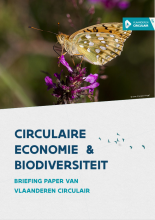
Climate change, pollution and biodiversity loss are combining to form an urgent global challenge. However, just like the crises themselves, the solutions to them are interconnected. In this briefing paper, Circular Flanders explores how the circular economy can contribute to protecting and restoring biodiversity.
You will discover why biodiversity is essential for our economy and well-being, how our current production and consumption system puts nature under pressure, and what role circular strategies can play in reversing this trend.
From reduced resource use and smarter design to regenerative production and new value models, this paper offers insight, inspiration and practical starting points.
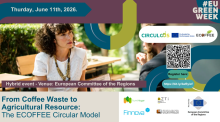
This EU Green Week Partner Event will present the innovative ECOFFEE circular model.
Discover how coffee grounds are transformed into high-value agricultural resources like natural biocides and animal feed, effectively bridging urban circularity with sustainable rural development.
Join the Hubs4Circularity Community of Practice for an online workshop to reflect, celebrate and make sense of the journey around the value of community in innovation.
ACR+ Days 2026: where circularity and bioeconomy meet. Over two days, participants will engage in high-level discussions, study visits and thematic sessions, with a strong focus on circularity, material resources management and bioeconomy.
The event will provide valuable opportunities for networking, knowledge exchange and collaboration within a community committed to advancing sustainable and competitive solutions in Europe.
The Hubs4Circularity Community of Practice is a network of partners from industries, regions and cities, set up under Horizon Europe to facilitate building, scaling up and replicating of ecosystems of industrial and industrial-urban symbiosis, and circular economy.
Come and learn about Hubs4Circularity initiatives and engage with experts and stakeholders from industry, regions and cities, policy, research and innovation!
This is the fourth edition of the strategic environmental monitoring reports that the Basque Ecodesign Center produces based on the knowledge acquired through its monitoring system.
The report compiles the latest regulatory and market developments driving the transition towards a decarbonised, more circular economy and explores how they are relevant to the value chains in which the Basque Ecodesign Center’s partner companies operate.
It identifies new standards and recognised methodologies that are relevant to those chains and identifies ten key challenges for the circular economy for 2026, such as security of supply and self sufficiency of materials as keys to competitiveness and circularity in the new geopolitical context.
This conference will focus on how circular ideas can be turned into economically viable, environmentally effective and socially beneficial business models under real-world conditions.
It will bring together strategic, operational and systemic perspectives on the circular economy and bioeconomy.
The CCRI hands-on online workshops will focus on a key implementation challenge identified in the CCRI communities of practice. They will translate those insights into practical tools, methods and examples that participants can apply in their own context.
This session will look at Consumption‑based emissions (CBE) which show the climate impact of what cities consume, not just what they produce. It will introduce what a Consumption‑Based Emissions (CBE) inventory is, what it can (and cannot) tell you, and how cities are beginning to use CBE insights to inform circular economy action.
The CCRI hands-on online workshops will focus on a key implementation challenge identified in the CCRI communities of practice. They will translate those insights into practical tools, methods and examples that participants can apply in their own context.
This session will focus on how planning can support the reuse of existing assets, limit land take, reserve space for circular activities and create the right conditions for circular design and material use in new developments.