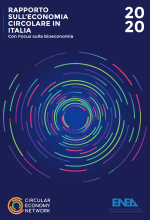
The 2020 Report on the Circular Economy in Italy, developed by CEN (Circular Economy Network) in collaboration with ENEA (Italian National Agency for New Technologies, Energy and Sustainable Economic Development) and Fondazione Sviluppo Sostenibile, analyses the state of play of the circular economy in Italy with, this year, a particular focus on the bioeconomy.
The report was presented during the 2nd National Conference on the Circular Economy livestreamed on 19 Marchfrom Rome. It was introduced by Edo Ronchi, President of CEN, and Roberto Morabito, Director of the Department for Sustainability, ENEA, and President of the Italian Circular Economy Stakeholder Platform (ICESP).
For a slide presentation of the report, click on the speakers Ronchi and Morabito.
Up to 90 million tonnes of food are wasted every year in the EU, half of which is generated at production and/or processing stage.
Being highly versatile and efficient, insects can bio-transform many of these materials (before they become "waste") into a wide range of higher-value products and ingredients that can further be included into the food and feed chains. Their added value goes beyond that of an alternative feed ingredient.
The lower Feed Conversion Ratio (FCR) of insects confirms their efficacy, but also their ability to concentrate lower value materials into ingredients of superior quality, such as proteins and lipids, in line with the natural nutritional needs of aquaculture, poultry or swine.
Samen werken aan circulaire fietsinfrastructuur. Een integrale en systematische aanpak by Stichting Circulair Bouwen is a report on a 2-year programme carried out with EU funds on building a circular bicycle road infrastructure. Over this period of time, valuable information has been gathered on how to promote and organize circular building efficiently.
To follow up on the programme, a multi-year project will be carried out in cooperation with governments, companies, educational institutions and NGOs, under the lead of the Radboud University Nijmegen, which will include two important policy fields:
encouraging cycling (low carbon, public health, better access to congested cities, car traffic reduction) and
The Dublin City University VALOR project is investigating potential recovery options for the Organic Fraction of the Municipal Solid Waste (OFMSW) and Bio-Stabilised residual waste (BSRW). The project fully diagnoses the recovery options for municipal solid waste and validates their use by determining their benefits and potential environmental risks.
The previous Commission policy on resources management was part of the priority for jobs and growth and economic competitiveness. The circular economy will be no less important for the new political priority of climate neutrality; it will become one of the indispensable elements for meeting the EU’s ambitions.
EU climate policy and the circular economy are, by and large, complementary and mutually reinforcing. The circular economy is more than just another ‘product standards’ policy.
Circular economy products for the foreseeable future will require both technology push and market pull policies. The principal challenge will be to create ‘lead markets’ for the circular economy in combination with low-carbon products.
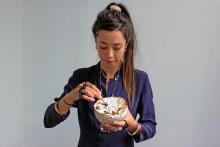
At the intersection of science, design, and waste management, PuriFungi develops natural cleaning systems. PuriFungi's new product is an ashtray made of mycelium and cigarette butts.
The SaltGae project hasestablished real scale demonstration sites in Slovenia, Italy and Israel that show the long-term techno-economic performance of microalgae technology for the efficient treatment of saline wastewaters from the food and beverage industries.
CuanTec is a Scottish blue biotech company that replaces plastic with natural alternatives. Sourced from waters of the Atlantic, CuanTec takes waste from fisheries and obtains the natural biopolymer chitin. Their process uses biology rather than chemistry to create chitin and chitosan of high quality and purity, which are in demand for over 3,000 industrial uses around the world.
Vlaanderen Circulairis the hub and inspiration for the Flemish circular economy. It is a partnership of policy makers, companies, civil society and the knowledge community taking action together. Its six core activities are:
Bringing together partners to tackle circular economy challenges
Creating knowledge to streamline policy-related research into policy measures for the circular economy in Flanders
Speeding up innovation and entrepreneurship
Assisting pioneers
Connecting local, Flemish, federal and European policy making
Embedding circular principles across Flemish civil society.
Suckõrs is an Estonian company that uses reed growing naturally on the shores of Estonia to make reusable, biodegradable drinking straws and a new raw material for producing goods. Their products can be cleaned and reused multiple times and, once they have reached the end of their lifecycle, they will decompose naturally.