As part of London Circular Economy Week, CLG Europe’s Materials and Products Taskforce will be hosting a webinar setting out EU circular economy policy.
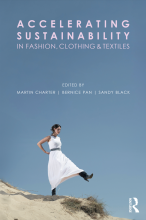
This book collates leading-edge research and industry best practice to provide a ‘one-stop shop’ exploring the complex and interconnected issues surrounding sustainability in the sector.
It includes innovative examples from different regions, addressing topics from policies to supply chain issues and materials innovation. Five unique case studies of sustainable businesses provide examples of pioneering practice. The book brings together both academic and industry perspectives on the critical areas that require immediate action to move towards a more sustainable fashion, clothing and textile sector.
Part VI features five chapters by leading authors covering the circular economy in the sector, including a chapter by Professor Jacqueline Cramer.
Public authorities - policymakers, procurement professionals, local and regional authorities, and other public sector actors - have an important role to play in the transition towards a more circular built environment and have a range of policy levers at their disposal to stimulate demand for circular skills. Using circular strategies in the built environment can help reduce the embodied emissions of building materials by 50%.
This interactive webinar will show how to train staff and how local authorities can work with stakeholders to train the whole value chain to promote circularity.
The webinar will present the guidance for policymakers as well as training materials developed by the BUS-GoCircular project. It will also explain how public authorities can use the Fundamentals Training Packs for SMEs in their requirements in tenders.
The BRILIAN project is designed to support the adoption of sustainable and cooperative business models in rural areas, enabling a smoother transition to bio-based economies. It plays a fundamental role in revitalising these regions and promoting sustainable economic and social development by transforming primary producers into active players in the supply chain, aligned with the goals outlined in the Common Agricultural Policy (CAP), the Green Deal and the European Bioeconomy Strategy.
Plastic multi-layer composites are often used to package food in a functional and safe way. However, current recycling technologies are unable to reprocess these multi-layer composites into high-quality materials and so they are excluded from the circular economy.
For flexible food packaging, recyclability is even more complicated due to the high hygiene and safety standards that recyclates must meet when reused in contact with food. This is why CIRCULAR FoodPack is developing innovative solutions along the entire recycling value chain to make flexible food packaging circular.
At the Circularity FoodPack conference on 23 November, project partners and experts will present the latest findings and developments.
Circular Week, an international series of events dedicated to sustainable development and the circular economy, will take place this year from 23 to 29 October.
Look through the full agenda of events and sign up!
Join this workshop on 10 October on citizen engagement during the 2023 European Week of Regions and Cities in Brussels! The event is organised in collaboration with the EU projects ARV, syn.ikia, oPEN Lab, and the FinEst Centre for Smart Cities.
The Pop-Machina project consortium is thrilled to invite policy stakeholders and decision-makers to participate on 14 September 2023 in its upcoming International Policy Roundtable focusing on the policy recommendations and lessons learnt during the project on circular economy, the maker movement as well as their convergence.
Selling or buying reconditioned items? Learn what the process involves in France!
To be recognised as reconditioned in France, an item has to follow a series of compulsory steps.
Sellers must be fully transparent about the source(s) of the product they are selling, reconditioning must take place on the premises where the product is sold or very close by. The product warranty must be extended to two years. Reconditioners should preferably use green transport and must be aware of their Extended Producer Responsibility and provide recycling bins for batteries, electrical appliances, etc. The original packaging should be preferably be used for packing the reconditioned goods.
These are just some of the rules that must be abided by in order to sell reconditioned items in France.
On 11 October 2023 in Brussels, the Circular Cities and Regions Initiative (CCRI) and the Hubs4Circularity (H4C) will host an onsite session during the European Week of Regions and Cities.
The session will focus on industrial symbiosis and circular value chains.
More information on the CCRI is available at the dedicated stand.