The Großes Walsertal region has developed a Circular Economy Strategy: it has set itself the objective of introducing circularity at every stage of the value chain, from production to consumption, repair and waste management. Smart product design and increased recycling and reuse activities will contribute to gradually close the loop of each product life-cycle in the region.
The Großes Walsertal communities act as role models by sharing tools, offering vouchers for local food stores (as part of the leisure activities funding) and implementing binding green criteria for events organised on their territory.
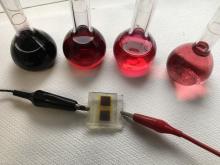
Giving value to waste as a precious renewable resource: for the first time, agri-food waste can be exploited to create photovoltaic cells that produce sustainable electricity. From the residues derived from winemaking (normally disposed of without any other use), researchers can extract natural dyes that capture solar energy, transforming them into a regenerated green resource.
DuCoop invests in sustainable technologies for the Nieuwe Dokken, the new circular districts in Ghent. The cooperative DuCoop provides systems for decentralized water sanitation with water re-use, 4thgeneration district heating and smart energy management. The company contributes to the climate ambitions of the city of Ghent, by closing the loops on water, energy and nutrients.
Bio-waste – mainly food and garden waste – is a key waste stream with a high potential for contributing to a more circular economy.
This European Environmental Agency Report provides an overview of bio-waste generation, prevention, collection, and treatment in Europe.
Bio-waste accounts for more than 34 % of the municipal solid waste. Many countries in Europe are far from capturing bio-waste's full potential. Food waste accounts for nearly 60 % of all bio-waste from households and similar sources. Preventing it is felt as an ethical responsibility for society.
Composting (with oxygen) and anaerobic digestion (without) are currently the two most widely applied treatment techniques. The latter generates biogas - renewable energy - and tends to deliver higher environmental benefits.
Calefa is a Finnish company specialized in the reuse of residual heat from industry by redirecting the excess heat from industrial processes either to the customer company’s own use or to the district heating network, instead of wasting it as condensed water or air.
The European Commission has decided to launch a €1 billion call for research and innovation projects that respond to the climate crisis and help protect Europe’s unique ecosystems and biodiversity. The Horizon 2020-funded European Green Deal Call is open for registration. It will spur Europe’s recovery from the coronavirus crisis by turning green challenges into innovation opportunities.
The second of four Thematic Working Groups created by the Interreg MED's Green Growth community was tasked with promoting green public procurement (GPP) by which public authorities seek to procure goods and services with reduced environmental impact throughout their life cycles.
This White Paper provides solutions for GPP and addresses issues linked to the lacking integration of sustainability and circular economy criteria in GPP and the provision of public services. It also highlights the need to develop the capacity of private actors to adopt eco-innovation and green energy in order to participate in green e-tenders.
The main objective is to examine public procurement in the context of long-term impacts, with specific attention paid to the role of public authorities.