The European Commission is currently accepting proposals for EU grants to help stakeholders take action against food waste. Fighting against food waste is one of the key action strands laid down in the EU’s Farm to Fork Strategy, which aims to make food systems fair, healthy and environmentally friendly.
The Hydro Ben project focuses on resource recovery for reuse in other industrial activities. It consists of recovering fatty substances from wastewater in professional catering facilities, by means of a special device which is placed under the sink.
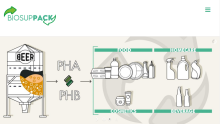
The BioSupPack project aimed to deliver novel, cost-competitive and versatile bio-based packaging solutions - based on PHA - that demonstrate high-performance for the packaging of food, cosmetics, homecare and beverage products as well as no environmental damage during & after their use.
France's Law Against Food Waste has become an international model for sustainable food policy. The law is often described as combining economic efficiency with environmental protection and social equity. However, stakeholder narratives cast doubt on whether this French CE law really contributes to social justice in the long run. This discourse analysis shows that:
the ban on food waste institutionalised a narrative about food waste that prioritises profit over social equity
the traditionally dominant solidarity narrative about food waste has been pushed back by the emerging CE discourse
As a consequence of this shift, activities enacted in the name of the CE may counteract social equity goals (for instance by establishing competition with charities).
Policies are focusing on halving food waste to help conserve increasingly strained food resources. However, expanding their scope of action to include dietary changes and complement targets with resource footprints has greater potential to save resources while avoiding trade-offs.
This paper shows that in Germany:
Healthy, plant-based diets are more effective at reducing land and biomass use than halving food waste
A combination of more plant-based food consumption and food waste reduction in distribution and consumption is most effective at saving resources
Focusing exclusively on food waste reduction as a policy target can be detrimental to the overarching goal of saving resources because it deflects attention away from more effective alternatives.
This literature review identified and categorised circular economy (CE) practices within all stages of the food and feed production chain in Europe to provide an overview of current and envisaged practices. There are four macro areas:
reducing food and feed waste in wholesale, food retail, catering and households and
reducing food and feed packaging waste.
It is recommended that future primary research in novel food and feed in the CE focuses on areas other than insect farming, and that there are further investigations into the potential risks associated with importation into the EU of livestock/goods that may have been subject to different restrictions/legislation.