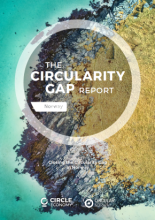
The Circularity Gap Report Norway is an in-depth analysis of how Norway consumes raw materials to fuel its societal needs. Currently, 97.6% of materials consumed each year never make it back into the economy.
Norway also has one of the highest per capita consumption rates in the world (44.3 tonnes per person). At 2.4%, its circularity rate is below the global average (8.6%). Each year Norway consumes 235 million tonnes of materials - metals, fossil fuels, biomass and minerals - to meet its internal needs.
However, the report reveals how Norway could see a 20-fold increase in its circularity by restructuring its businesses and industry through 6 key actions in the following fields:
PC4Change is a project of the Reware Cooperative - Social Enterprise, specialized since 2013 in the refurbishing of computers dismissed by large companies.
On average, a European citizen produces half a ton of waste a year. This amounts to 2.5 billion tons yearly for the entire European Union.
The Joint Initiative on Circular Economy (JICE) is a partnership between the EU’s largest national promotional banks and institutions and the European Investment Bank to invest at least €10 billion in the circular economy by 2023.
It provides loans, equity investment, guarantees, innovative financing structures and technical assistance.
The initiative will support projects that prevent and eliminate waste, increase resource efficiency and promote circular business models. Eligible projects can be submitted to the respective JICE partners.
The Dutch economy is 24.5% circular. Measures in four key sectors can triple the national circularity rate and help the government achieve its ambitions for a fully circular economy by 2050.
On 3 June, Circle Economy launched the Circularity Gap Report for the Netherlands. The report shows that the Netherlands is a circular frontrunner: the country's circularity rate is three times higher than the global rate of 8.6%. Consuming 221 million tonnes of materials each year, the Netherlands retrieves one quarter from non-virgin, secondary sources. However, if the government is to achieve its ambitions of full circularity by 2050, a major overhaul of the national economy, including jobs, will still be necessary.
This review paper of Mark Anthony Camilleri examines relevant regulatory guidelines, policies, and recommendations on sustainable development, where it traces the origins of circular economy (CE). It goes on to shed light on key theoretical underpinnings of CE's closed loop and product service systems.
The findings suggest that the CE's regenerative systems minimise the environmental impact as practitioners reduce their externalities, including waste, emissions, and energy leakages through the use and reuse of resources. Therefore, this contribution offers a critique on CE's inherent limitations and discusses about the implications of having regulatory interventions that are intended to encourage responsible consumption and production behaviours.
The Dublin City University VALOR project is investigating potential recovery options for the Organic Fraction of the Municipal Solid Waste (OFMSW) and Bio-Stabilised residual waste (BSRW). The project fully diagnoses the recovery options for municipal solid waste and validates their use by determining their benefits and potential environmental risks.
WRAP is a global environmental action NGO transforming our broken product and food systems to create circular living for the benefit of climate, nature and people. It aims to embed circular living in every boardroom and every home.
For over twenty years, WRAP has delivered programmes to benefit the environment, from reducing CO2 emissions and waste to restoring nature and enhancing people’s lives. It began in the UK in 2000 but is now global in scale.
Its goal is to drive the transition to a circular economy by keeping products and materials in use for longer, supporting innovation, adopting new business models and increasing the amount of material that is reused or recycled, as well as minimising waste and reducing the reliance on virgin materials.
Water2REturn was an Innovation Action co-funded by the European Commission under its Horizon 2020 programme. It focused on the recovery and recycling of nutrients from slaughterhouse wastewater as part of a circular economy model.