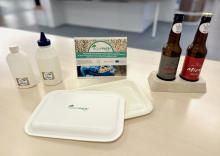
The BioSupPack project aimed to deliver novel, cost-competitive and versatile bio-based packaging solutions - based on PHA - that demonstrate high-performance for the packaging of food, cosmetics, homecare and beverage products as well as no environmental damage during and after use.
Russia is among the larger suppliers of raw materials to the EU. It is the biggest world supplier for palladium, platinum and nickel, and a prominent one for aluminium and copper. The country still holds large untapped reserves of rare-earth elements.
This paper provides an overview of EU import dependency on raw materials and Russia’s share among EU sources of key supplies for low-carbon technologies. It then looks at prospects for meeting future material demands through circularity for three technologies, namely lithium-ion batteries, wind turbines and fuel cell electric vehicles.
The analysis is based on two scenarios with different levels of ambition. They aim to give an indication of the scale of potential benefits that can be achieved through circular approaches.
This book provides answers on how to govern the transition to a circular economy in different socio-cultural and political contexts.
It is intended to help the global changemakers who are building our circular future. Author Jacqueline Cramer spoke with 20 representatives of circular hotspots worldwide, thoroughly analysed their different contexts and extracted 10 key takeaways. Everyone working on circular initiatives can use these and adapt them to their own socio-cultural and political contexts.
This initiative is powered by APPLiA - Home Appliance Europe, representing home appliance manufacturers from across Europe.
The Circular Appliances website takes readers through each phase of the home appliance lifecycle, from design to end-of-use. There is a straightforward description of each phase and statistics on this sector.
The Circular Culturewebsite provides a platform for all those who would like to share their practices and recommend innovative solutions for different topics, such as food waste prevention, recycling and resource efficiency. There is a collection of circular projects.
AIMPLAS, the Plastics Technology Centre, has now completed the fourth and final year of the RepescaPlas project. The project has developed a complete management system for plastic waste recovered from the sea and subsequent recycling into products of commercial value.