The new Circular Economy Action Plan identifies textiles as a key product value chain with potential to boost the EU market for sustainable and circular textiles. The European Commission is organising a series of targeted stakeholder workshops to gather input on challenges and gaps as well as opportunities for the sector towards sustainability. Join the second workshop on 2 June 2021!
The New Circular Economy Action Plan identifies textiles as a key product value chain where there is potential to boost the EU market for sustainable and circular textiles. The European Commission has launched a public consultation to gather input on challenges and gaps as well as opportunities for the sector towards sustainability.
ReBlend develops textiles and textile products made from textiles that otherwise end up in incineration. Textiles made from recycled fibres offer a positive alternative for designers and companies. In collaboration with waste collectors, producers, designers, makers and visionaries, ReBlend organises a full supply chain from start to finish to accelerate a new ecosystem for circular textiles.
CONTINUED is a circular e-commerce platform for fashion.
It was launched in 2017 with the aim of creating a generic software solution for circular consumption in the fashion industry. Recirculating clothes is up to 3000% more efficient than reusing material in reducing the fashion industry's environmental footprint.
The platform connects up brands and consumers. It offers dashboard tools for Sales, Inventory, Finance and Impact, as well as a Webshop back-end supporting several rent/resale models, account management and payment.
CONTINUED is fashion as a service and sustainability as a product. It lets brands explore future business opportunities based on the circular economy while carrying out existing business activities.
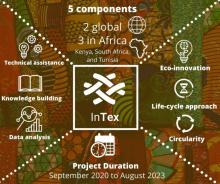
"Innovative Business Practices and Economic Models in the Textile Value Chain" (InTex) is a three-year UNEP project funded by the European Union. The InTex project has five components, two with global reach and three focusing on national implementation in three African countries: Kenya, South Africa and Tunisia.
A new partnership led by the UNIDO is looking for interested organisations to express their interest in joining ‘SWITCH to Circular Economy Value Chains’ - a five-year European Union-funded project that aims to accelerate the transition to more circular value chains (namely textiles and garments, and plastic packaging) in developing countries.
Five consortium partners, including Ecopreneur.eu, have kicked off an EU-COSME funded project “Fashion For Change”. Over the next 3 years, they will help SMEs, designers and start-ups from the European fashion sector scale-up and accelerate their sustainable businesses while increasing awareness about circular fashion among stakeholders, including consumers. Share your views in the quick poll.