Despite growing efforts by political bodies, companies and researchers to support the transition towards a more sustainable and circular economy, we are still behind schedule.
The seminar on 17 October will address the following challenges that are slowing down this transition:
the need for quantitative but easy-to-handle methods to support decision-making in the product design phase, particularly concerning material selection for sustainability,
the potential rebound effects that undercut the expected sustainability gains of moves towards circularity.
As part of London Circular Economy Week, CLG Europe’s Materials and Products Taskforce will be hosting a webinar setting out EU circular economy policy.
This event organised by PwC Germany and the Internationale Bauausstellung 2027 StadtRegion Stuttgart GmbH will launch a circular building and construction network
During the kick-off session taking place in Germany on 7 November, various practitioners and industry experts will give insights into circularity, covering topics such as innovative materials, regulatory frameworks and financial perspectives. An interactive session will also be an opportunity for networking and discussions. The event, which will be held in German and take a national perspective, is relevant to all players active in the buildings and construction sector.
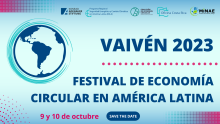
VAIVÉN 2023: Circular Economy Festival is a meeting and exchange space of the Circular Economy Coalition for Latin America and the Caribbean that seeks to promote and celebrate the development of the circular economy in the region.
Public authorities - policymakers, procurement professionals, local and regional authorities, and other public sector actors - have an important role to play in the transition towards a more circular built environment and have a range of policy levers at their disposal to stimulate demand for circular skills. Using circular strategies in the built environment can help reduce the embodied emissions of building materials by 50%.
This interactive webinar will show how to train staff and how local authorities can work with stakeholders to train the whole value chain to promote circularity.
The webinar will present the guidance for policymakers as well as training materials developed by the BUS-GoCircular project. It will also explain how public authorities can use the Fundamentals Training Packs for SMEs in their requirements in tenders.
In recent years, the concept of green jobs has been the focus of increasing attention. The principles of green jobs and green employment are grounded in a variety of evolving concepts such as green economy, green growth, sustainable development and circular economy, which are multi-dimensional and their understanding evolves in both academic and political contexts.
At the EU policy level, the green transition is seen as an opportunity to create jobs in existing and emerging economic sectors. A large number of different approaches to how green jobs can be defined and classified have been put forward. Differences and gaps identified in these existing definitions and frameworks have exposed the need to create a novel, integratedtaxonomy for green jobs, which is developed in this report.
Nordic Circular Summit is the biggest annual conference on the circular economy in the Nordic region. NCS2023 will take place on 17–18 October, both in person in Reykjavik, Iceland and online. It will be co-hosted by Nordic Circular Hotspot and Nordic Innovation and is an official World Circular Economy Forum Side Event and a pre-event to the prestigious Arctic Circle Assembly.
The Expert Forum on Photovoltaic and Hydrogen Materials Driving the Net-Zero Transition will take place on 21 September 2023. It is the first in the Expert Forum Series happening across Europe and will delve into the pivotal role played by materials in facilitating the transition to a future with zero carbon emissions.
This forum will focus on the significance of materials in hydrogen and solar energy. It will explore the latest developments in materials, science and engineering by bringing together stakeholders from academia, industry and research. These developments have the potential to enable the efficient and sustainable production and utilisation of hydrogen, and to enhance the performance and circularity of solar energy systems.
The BRILIAN project is designed to support the adoption of sustainable and cooperative business models in rural areas, enabling a smoother transition to bio-based economies. It plays a fundamental role in revitalising these regions and promoting sustainable economic and social development by transforming primary producers into active players in the supply chain, aligned with the goals outlined in the Common Agricultural Policy (CAP), the Green Deal and the European Bioeconomy Strategy.
The Transition Pathway for the Textiles Ecosystem was published on 6 June 2023. It is an EU initiative which seeks to build a greener, more circular and digital future for the textiles ecosystem and to make it more resilient and competitive. The pathway, the outcome of a co-creation process with stakeholders, is a comprehensive framework that identifies specific actions. 50 actions have been outlined within eight building blocks, with a timeframe for implementation and a clear picture of the key actors involved. This is a call for commitments.