On 26 April the municipality of Wiltz, considered to be the "Municipal Hotspot of the Circular Economy in the Grand Duchy of Luxembourg", will hold the annual "Circular Economy Day" conference. This event aims to promote the circular economy at national and regional level by sharing the experience and know-how established through multiple projects and by activating and consolidating the network of stakeholders active in the circular field. The 2023 event will focus on urban metabolism.
The City of Roubaix's Circular Economy Unit is hosting the Roubaix Circular Economy Forum on 30 and 31 March 2023. This event aims to bring people together (everyone from members of the public to CEOs and European partners) to explore and raise awareness about the circular economy.
This in-person event in Brussels on the morning of 17 May will explore some of Europe’s best practices on waste prevention, implemented by coastal municipalities and regions.
It will bring together local actors behind these best practices and representatives from Brussels, in order to better understand how local actions can inform key forthcoming legislative decisions on plastic production, use and waste.
Tyres are complex products essential to the mobility of millions of Europeans. Likewise, tyre recycling is essential to the sustainability of the entire tyre value chain, be it in terms of resource efficiency or climate neutrality. Yet, despite a landmark landfill ban in 2006, much needs to be done to improve the circularity of tyres. To give an order of magnitude, today, for one tyre that is recycled, one tyre gets incinerated for energy recovery, and the worse in terms of end-markets opportunities is yet to come.
The EuRIC conference on tyre recycling takes place in Brussels on 18 April 2023.
Since 2013, the EU Ship Recycling Regulation has provided a regulatory framework for the recycling of EU-flagged ships. It acts as a benchmark for ship recycling legislation around the world.
The European Commission has launched an online public consultation on the evaluation of the Ship Recycling Regulation that will run until 7 June 2023.
We must better link the EU circular economy agenda with food security and safety-related challenges. The packaging industry can support the EU's sustainability ambitions for recyclable packaging by encouraging innovations and circular actions along the whole value chain.
How can the revised PPWD secure investments in sustainable food packaging solutions? And what role can consumers play when it comes to the implementation of the PPWD in practice? These are some points to discuss on 6 September 2023 from 10:00 during the #EUCircularTalks.
This report looks at whether, and to what extent, the EU recycling targets can be met through improved recyclability of packaging and increased separate collections of municipal waste.
It examines the role mixed waste sorting (MWS) could play in three EU countries with high recycling performance – Germany, Belgium, and Sweden.
The conclusion is that in addition to separate collection and improved recyclability of plastic packaging, a full roll-out of effective MWS is necessary to meet recycling targets consistently, and to ensure progress towards the EU’s wider carbon emissions reduction goals.
This conference brings together regional and national governments, mixed waste sorting operators, recyclers, experts, and technology providers from countries across Europe to share their expertise on the introduction of MWS as an additional tool for the recovery and re-circulation of Europe’s valuable resources.
The conference is a timely response to the current revision of the EU’s Waste Framework Directive and the Industrial Emissions Directive.
Textiles are on average the fourth-highest source of pressure on the environment and climate change from a European consumption perspective, as shown in previous EEA briefings.
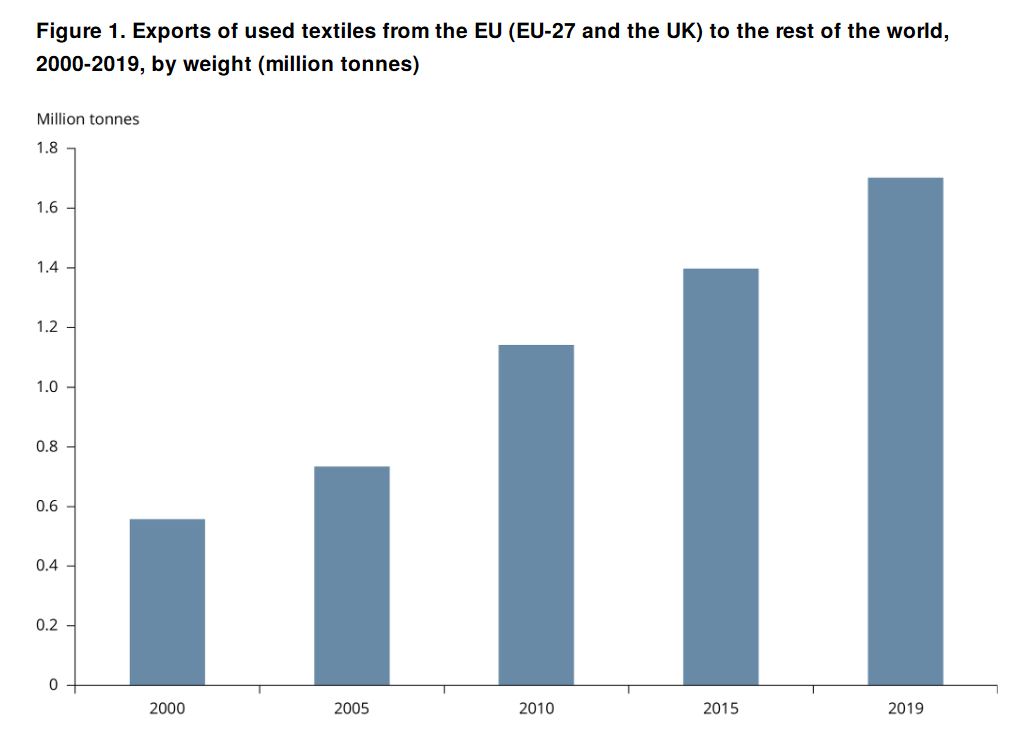
Europe faces major challenges managing used textiles, including textiles waste. As reuse and recycling capacities in Europe are limited, a large share of used textiles collected in the EU is traded and exported to Africa and Asia, and their fate is highly uncertain.
The common public perception of used clothing donations as generous gifts to people in need does not fully match reality.
In the course of two decades, there has been a threefold increase in EU used textiles exports
Interested in circular plastics? Join the interactive webinar "A Circular Economy for Plastics in Canada & the Netherlands" on 5 April to learn more about current policy approaches, best practices, latest technologies and market opportunities in the Netherlands and Canada.