The Loop Company has discovered the opportunities offered by the circular economy and launched three initiatives - Book in Loop, BabyLoop and UniLoop - that bring circularity to everyday life.
The Expert Group on Circular Economy Financing has developed this guide to support public authorities in identifying the most suited incentives to speed up the transition towards a circular economy at national, regional or local level. Incentives aim at addressing market failures that prevent or delay the transition towards circular products, services and solutions.
C2C ExpoLAB was a consultancy firm which specialised in the practical application of Cradle to Cradle (C2C) principles in the built environment. It enables its clients to exploit the circular economy concept. One of its projects was Venlo city hall which illustrates its approach and principles.
Leadax uses high-tech material and production knowledge to develop and manufacture 100% circular materials out of discarded PVB for waterproofing buildings.
Green Serendipity is an international consultancy firm with a focus on renewable plastics for packaging and products. It advises businesses on how to develop circular concepts and strategies for packaging and products.
Over the past decades concepts such as sustainability and industrial development have slowly come to the same operational logic, as demonstrated by a growing interest in exploring and describing the synergy between developments in the circular economy and industrial digitalisation. There is agreement on their complementarity evolution paths, but no outlook is available regarding the co-evolution staging and structuring. This paper based on desk and empirical research presents an approach to outline the likely path of evolution.
So far, the notion of transition to sustainability has been applied in single sector studies, while reality indicates that the systemic change required cuts across thematic technologies and sectors. The approach taken can be useful to enrich current analyses.
Schijvens has been producing corporate uniforms for more than 150 years now. In 2017, they began collecting customers' old clothing, shredding it and mixing the textile fibres with shredded PET-polyester ones from sportswear, fishing nets and bottles. This led to 100% recycled yarn, which is used to make new fabrics and ultimately new uniforms.
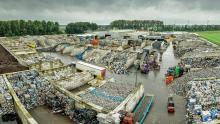
Van Werven Plastics Recyling specialises in creating high-quality raw materials from post-consumer hard plastics, collected from construction waste, industrial waste and municipal recycling centres. Van Werven has a separate machine for each type of plastic, as every material has its own properties.
Groningen Seaports is the economic operator, developer and port authority for the port of Delfzijl, Eemshaven and adjoining industrial sites. Groningen Seaports is at the forefront of the circular economy and recently opened Circulands, a circular-oriented industrial park.
As an impact leader and frontrunner promoting resource circularity, TOMRA has extensively explored, analysed and collaborated with value chain partners to address the ever-increasing global problem of waste. This white paper presents the challenges, projections and opportunities involved in managing post-consumer waste in developed and developing countries. It describes how society can speed up the transition to a circular economy by collecting and recycling waste, especially plastic packaging and other carbon-intensive materials.
The white paper can be downloaded from TOMRA's website, but this requires registering in a third party's data base and submitting your email address.