Join this workshop on 10 October on citizen engagement during the 2023 European Week of Regions and Cities in Brussels! The event is organised in collaboration with the EU projects ARV, syn.ikia, oPEN Lab, and the FinEst Centre for Smart Cities.
FEAD, the European Waste Management Association, invites you to an in-person conference to take place in Rimini, Italy, on Wednesday 8 November 2023. The event will explore the presence of PFAS in waste.
Europe and the world face unprecedented sustainability challenges, largely as a result of unsustainable consumption. Since similar consumption patterns are expected to continue, technological and efficiency gains are likely to be insufficient to keep environmental and climate pressures within sustainable limits.
A more circular economy in Europe has the potential to reduce environmental and climate pressures and impacts from our consumption, but will require reshaping our consumption and production systems. This report presents trends in European household consumption and its environmental and climate pressures, and explores conditions for and pathways to a transition towards more sustainable and circular consumption patterns in Europe.
Consumers play a key role in unlocking the potential of the circular economy. This interactive webinar on 18 September 2023 at 10:30-12:00 CEST will address pathways to more sustainable and circular consumption in Europe. A panel of experts from the European Commission, the Ellen MacArthur Foundation, the Hot or Cool Institute and the European Consumer Organisation (BEUC) will share insights into and perspectives on the current debate on policy options for the shift towards sustainable consumption in Europe.
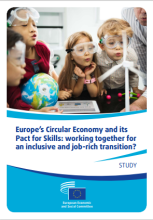
New skills development is one of the conditions for moving towards the circular economy.
However, closing the materials cycle while eliminating waste according to repair, reuse and recycle principles requires specific strategies and processes.
First, it is imperative to understand the skills needed to design and subsequently implement these strategies and processes. Then, we need to develop these new skills, both within the education system and in the labour market.
The study reviews recent analyses in order to understand the green or circular skills of the future identified to date in sectoral and EU-wide research. It also examines EU initiatives on skills development for circularity.
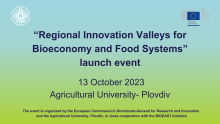
This launch event on Regional Innovation Valleys for Bioeconomy and Food Systems will take place on 13 October 2023. It is organised jointly by the European Commission's Directorate-General for Research and Innovation and the Agricultural University of Plovdiv, in close cooperation with the BIOEAST Initiative. It will be webstreamed and recorded.
This paper - part of the A Circular Economy Vision series - follows one of Circular Innovation Lab's previous analyses of the potential effects of the European Critical Raw Materials Regulation (ECRMR) on developing economies.
It focuses on the EU’s domestic critical raw material (CRM) markets, revealing how the current hyperfocus of the policy on extraction, processing and recycling is not applicable to all identified CRMs. By analysing the limits of the ECRMR as it stands, the paper argues that a supporting structure of circular economy legislation could promote a successful ECRMR for all CRMs, not just those that could benefit from recycling infrastructure.
The paper provides detailed policy recommendations for each CRM where data allow.
The European Commission has launched three calls for input: on eco-design requirements and labelling of electronic displays, on the WEEE Directive and on the new end-of-life vehicle rules.
Do you feel strongly about any of these issues? Then tell the Commission!
The new Horizon Europe Cluster 6 calls for proposals related to the circular economy will be open for submissions until 22 February 2024. EUR 120 million will be available in the form of grants to cover safe, integrated circular solutions at regional and sectoral levels for important material flows and product value chains.
DiCE (Digital Health in the Circular Economy) has been created to bring key stakeholders together to address challenges associated with the growing use of digital healthcare products and increasing demand for raw materials to manufacture new electronic devices and other equipment.