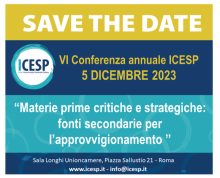
ENEA is organizing the 6th annual conference of the Italian Platform of Stakeholders for the Circular Economy (ICESP) in Rome and online on 5 December 2023 (9:30-16:15 CET). It will serve as a forum for extensive discussions among various stakeholders, including institutional and entrepreneurial entities, to explore ongoing initiatives concerning the procurement of secondary sources for critical and strategic raw materials.
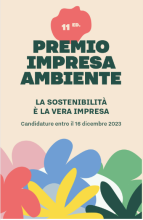
"Premio Impresa Ambiente" is the highest Italian award for companies and public and private bodies that have made an innovative contribution to processes, systems, partnerships, technologies and products furthering sustainable and circular development. Apply by 16 December 2023!
A newly launched report by the Norwegian Climate Committee 2050 (available in Norwegian) provides a comprehensive analysis of the challenges Norway faces in meeting its climate targets, highlighting problem areas such as consumption, emissions and biodiversity. It shines a spotlight on a significant gap between stated ambitions in current climate policies and the measures actually adopted.
To bridge this gap, the report makes several key recommendations (available in English), including outlining the role that the circular economy plays in solving the climate crisis.
As a growing community of European frontrunner festivals, Green Deal Circular Festivals strives for fully circular and climate neutral festivals, as festivals can play a guiding role in inspiring a green movement and accelerate society’s transition.
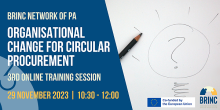
While procurement can be an accelerator for circular economy in organisations, scaling up the positive outcomes of successful pilots can be difficult, due to specific internal agreements, culture and values (organisational attitude).
This third training session of the BRINC Network of Public Authorities will provide suggestions and advice on how to change and evolve governance structures (mindset, attitude, culture), to support the implementation of circular economy within your organization.
The transformation into a circular economy entails factoring resource flows into production, sales and consumption processes and thus massively reducing the use of materials (raw or otherwise), as well as the volume of waste and the strain on the environment.
Austria's circular economy strategy therefore aims to:
This series of webinars - each aimed at a specific target audience and hosted by BUILD UP - will highlight how different stakeholders could join forces to reskill and upskill the building sector workforce with circular skills by highlighting the main takeaways and outcomes of the EU-funded project BUS-GoCircular.
The Romanian Government has approved an Action Plan promoting the Circular Economy as part of the National Strategy for the Circular Economy (NSCE). The action plan sets out a national vision for speeding up the transition to a circular economy, with measures geared to the nine economic sectors with the greatest potential for circularity in Romania's economy: agriculture and forestry; automotive; construction; food and beverages; packaging; textiles; electrical and electronic equipment; waste; water; wastewater.
The action plan has a cross-sectoral strand including promotion activities and a monitoring platform. It also stipulates 52 priority measures scheduled to be rolled out between 2024 and 2032.
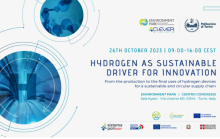
On 26 October, Environment Park in Turin (Italy) will host the event Hydrogen as Sustainable Driver for Innovation - From the production to the final uses of hydrogen devices for a sustainable and circular supply chain.
Taking an overall lifecycle perspective to production, design, manufacturing and the final use of hydrogen devices, this event will explore the sustainability dimension of some of the main steps in the hydrogen value chain.