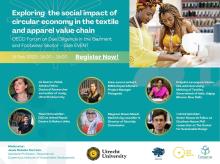
Circular economy take-up by companies in the textiles and apparel sector has increased significantly in recent years, but we know relatively little about how current circular business models affect workers and communities.
In this session on 14 February, Utrecht University's Copernicus Institute of Sustainable Development, Smart Green Industry and Conserve India will explore the outcomes of their most recent social impact study on the apparel value chain.
The World Circular Economy Forum 2023 will be held in Helsinki from 30 May to 2 June 2023. This global collaboration forum is co-organised by Finnish Innovation Fund Sitra and Nordic Innovation, with international partners. It will attract more than 2 000 leading circular economy players in the world to Finland to find circular solutions that can help our economies fit within the boundaries of nature. Part of the programme will also be accessible online.
The Circular Navarre Catalogue 2022 is an update of the showcasing booklet published in 2020 and in 2021. This new edition includes 50 organisations - based on circular business models - in the Spanish Navarre region, looking for international cooperation.
UNEP and Global Fashion Agenda are holding a COP27 side event on Circular Systems for a Net Positive Fashion Industry in Sharm El-Sheikh, Egypt, on 12 November at 18:00 EET. This in-person talk show event with industry leaders will discuss the path to a circular fashion system, from circular design to business models and recycling to public behaviour.
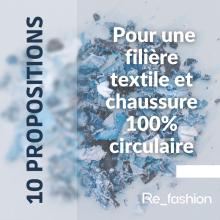
The textile industry’s figures are clear: of the 648 000 tons of textiles placed on the market each year in France, only 38% are collected for recycling.
The 10 proposals set out in this white paper (in French) seek to meet three objectives. The first consists of building the Extended Producer Responsibility approach around environmental benefits. The second is to support the development of a sustainable textile and footwear recycling industry. The last is to meet the legitimate expectations of transparency and traceability. The proposals aim to achieve these objectives in the context of the three key steps in a product’s lifecycle: (1) fabrication, (2) consumption, and (3) regeneration.
Flanders DC and Circular Flanders have developed a tool to guide fashion entrepreneurs through the basics of a more sustainable way of working. With this online platform they want to encourage the industry to steer clear of a linear system (take-make-waste) and to embrace a more circular approach instead (with a focus on durability and avoiding waste).
The fashion sector is awash with certification schemes, sustainability labels and multi-stakeholder initiatives all seeking to steer the industry onto a greener course. Such schemes serve a dual purpose for the brands. As the fashion industry is one of the least regulated sectors in the world, they partially exist as a genuine attempt to move towards sustainability but they also enable ‘greenwashing’.
This report has sought to assess whether certification schemes, labels and multi-stakeholder initiatives are fit for purpose and what role they play in addressing the damage done by the fashion industry. The findings show that the majority of schemes offer a false promise of certification for textiles and a highly sophisticated form of greenwashing.
In the context of a three-year project on “Innovative Business Practices and Economic Models in the Textile Value Chain” (InTEX), UNEP is seeking an Implementing Partner to support its impact assessment work on sustainable economic pathways for sustainable and circular textiles. The deadline for submitting proposals is 16 May 2022.