Rue Rangoli is a French social enterprise that supports social organisations involved in upcycling or zero-waste and the design circular economy, based in Europe, Africa and Asia.
The coronavirus crisis has disastrous human and economic consequences, revealing our system's exposure to a variety of risks. As the pandemic forces us to adapt our daily lives in ways we would not have imagined, it is also challenging us to rethink the systems that underpin the economy.
While addressing public health consequences is clearly the priority, before the crisis, momentum had already been increasing around the need for a system reset, and the potential of a circular model.
Far from the pandemic pushing the circular economy agenda to the bottom of the list, this article by Jocelyn Blériot at the Ellen MacArthur Foundation highlights and reiterates that it is now more relevant than ever, and sets out to explore the wider possibilities for recovery.
The cleanSpot application provides users with an easy way to search for recycling centres and specialised recycling containers where they can drop off their non conventional urban waste for correct recycling.
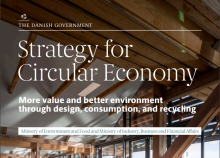
In 2018, the Danish Ministry of Environment and Food and the Danish Ministry of Industry, Business and Financial Affairs launched a Strategy for Circular Economy, based on recommendations by an Advisory Board for Circular Economy. The strategy will be implemented in the period 2018-2022. The government launched initiatives within six thematic areas:
Strengthening enterprises as a driving force for circular transition
Supporting circular economy through data and digitalisation
Promoting circular economy through design
Changing consumption patterns through circular economy
Creating a proper functioning market for waste and recycled raw materials
The city of Leuven, in Flanders, aims to play a leading role in initiating systemic change in cities and society at large.
The Roadmap 2025 · 2035 · 2050, drawn up by Leuven 2030 and numerous experts, serves as a guide to achieving the goal of a climate-neutral city by 2050. In September 2019 a professional team of programme managers started on no less than 13 specific programmes, which will transform this unique plan into concrete actions and impact on the field.
Leuven Circulair finds its place in specific programme #09, outlining key actions for circularity in the city with a strong focus on social, repair, refurbishment, knowledge and expertise from the University of Leuven and local fablabs.
How can sustainable consumption and longer lifetime of products be promoted through consumer protection legislation?
This in-depth analysis investigates the contribution, or lack of contribution, of the current EU consumer protection legislation to sustainable consumption and longer lifetime of products. In addition, it gives an overview of the most relevant best practices at national and international level and provides recommendations on the future development and possible reforms of European consumer protection legislation with a view to more sustainable consumption and longer lifetime of products.
This study was commissioned by the European Parliament Committee on Internal Market and Consumer Protection (IMCO).
How can the EU product safety and compliance framework help promote product durability and tackle planned obsolescence, foster the production of more sustainable products, and achieve more transparent supply chains for consumers?
Product longevity can play a useful role in achieving the Paris Agreement goals – material efficiency is an important contributor to energy efficiency and is also important in its own right. The product safety and compliance instruments available at European level can contribute to these efforts, if wisely applied.
This study was commissioned by the European Parliament Committee on Internal Market and Consumer Protection (IMCO).
This review paper of Mark Anthony Camilleri examines relevant regulatory guidelines, policies, and recommendations on sustainable development, where it traces the origins of circular economy (CE). It goes on to shed light on key theoretical underpinnings of CE's closed loop and product service systems.
The findings suggest that the CE's regenerative systems minimise the environmental impact as practitioners reduce their externalities, including waste, emissions, and energy leakages through the use and reuse of resources. Therefore, this contribution offers a critique on CE's inherent limitations and discusses about the implications of having regulatory interventions that are intended to encourage responsible consumption and production behaviours.
new obligations with the creation of new producer responsibility sectors to include new product families in the circular economy (toys, sports and do-it-yourself equipment, building materials, cigarette butts, sanitary textiles);
new prohibitions on single-use plastics and to fight waste of food and non-food unsold products;
new tools to better control and sanction offences against the environment (greater power for mayors to combat littering and illegal dumping), to support companies in their eco-design initiatives (bonus/malus-type incentives) and to assist citizens in new consumption practices (repairability index, information on environment and health impacts of products, harmonisation of info on sorting, etc.).
The campaign “Be a Miljönär” [a pun which merges miljö (environment) with miljonär (millionaire)] has a long-term goal: reducing waste and making sustainable consumption a habit among people aged between 18 and 30.