The Sustainable products initiative, which will revise the Ecodesign Directive and propose additional legislative measures as appropriate, aims to make products placed on the EU market more sustainable. You are welcome to give your feedback on it until 2 November 2020.
This case study on the EU's Circular Economy Plan (CEAP) by the Ellen McArthur Foundation reflects back on the steps which the European Commission took to take a lead in circular economy policies globally. From initially aiming at improving resource efficiency, to redefining growth with positive social, environmental, and economic benefits, this case study analyses this policy-making process.
The CEAP was a comprehensive body of legislative and non-legislative actions adopted in 2015, which aimed to transition the European economy from a linear to a circular model. It mapped out 54 actions, as well as four legislative proposals on waste.
By rethinking resource efficiency and material flows, the European Commission has developed a framework to promote systemic change.
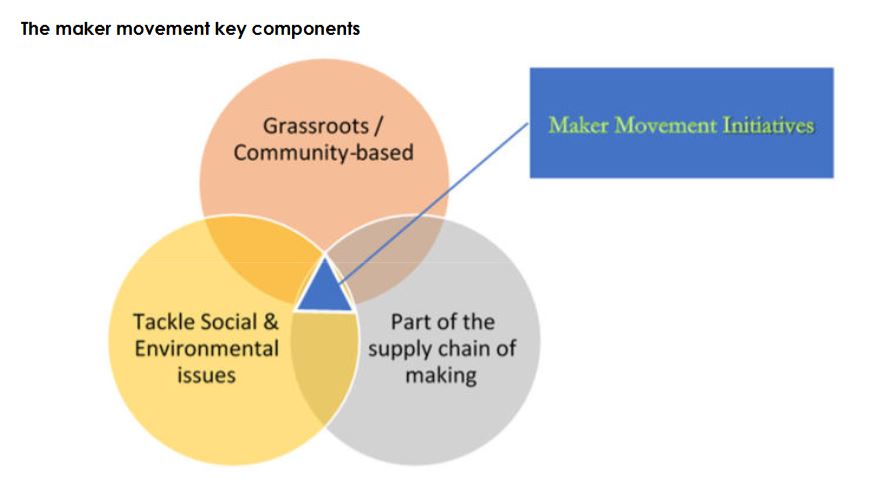
The Pop-Machina project is an EU-funded research project exploring the maker movement contributions to cities’ transition to the circular economy.
This 2nd deliverable 'Mapping the maker community ecosystem and the urban metabolism processes' draws a collection of definitions to characterise the circular maker movement. A set of original tools, including a decision tree, a taxonomy, indicators and maps of the circular maker movement are developed to delineate the circular maker movement, with a focus on the Pop-Machina seven pilot cities.
Eventually, pilot story-boards present the current status of the circular maker movement in the city, with the disclosure of the circular maker passports, characterising the movement in each pilot.
The aim of Poland's Roadmap towards the Transition to the Circular Economy (CE), which was adopted in 2019, is twofold: first, to identify cross-cutting measures capable of having the broadest possible impact in Poland, both socially and economically; and second, to prioritise areas that will enable Poland to take advantage of its current opportunities, and to deal with existing or future challenges.
The Roadmap focusses on 5 areas in particular:
Sustainable industrial production
Sustainable consumption
Bioeconomy
New business models
implementation, monitoring and financing of CE.
The Roadmap includes a set of tools, which are not purely legislative, to create the conditions for a new economic model in Poland.
PCDT buys used spare parts for home appliances from individuals whose appliances cannot be repaired and will then sell thems - with no margin of profit - to customers who can use them to repair their own appliances.
However, on behalf of the European chemical distribution sector, particularly the numerous SMEs it represents, Fecc would like to raise the following points:
increasing recycled content in products while ensuring their performance and safety is paramount
stakeholders from across the board – private companies, academia, and public bodies – can all benefit from circularity in the distribution sector
promoting circular public procurement to empower consumers and public buyers is necessary and must be supported post-COVID-19.
In 2019 the European Commission set out a policy guideline to address global environmental challenges and circularity. EURATEXand its members welcome the ambition of the EU Institutions to change the old way and commit to engage with all relevant parties to deliver and implement a new Textile Strategy to boost the circular economy and be fit for the present and future generations.
This strategy by EURATEX is a starting point, with insights into solutions based on a 14-month consultation with members, involving over 100 companies and key stakeholders, focused on applied circular practices and future opportunities. It prioritises removing barriers to a large-scale uptake of circular economy in textiles, sets out 12 key points and puts forward 38 proposals.
The report from TCO Development, the organization behind the global sustainability certification for IT products TCO Certified, explains how everyone who buys/uses IT products can implement circular practices. It sets out how circular economy (CE) helps solve many pressing sustainability challenges linked to IT products and contains 33 expert tips on circular IT management.
Key findings:
Use IT products longer.
Circularity helps maximize the value of IT investment.
Market demand is key to accelerating the pace of change.
Circularity includes IT management throughout the life cycle.
Improved supply chain responsibility can speed up transition to CE.
Circularity is a team effort.
Many circular solutions are already in place - just use them.
Holland Circular Hotspot is a private-public platform in which companies, knowledge institutes and local authorities collaborate to promote and support international collaboration and knowledge exchange on Dutch circular economy, and the Netherlands Enterprise Agency, a government agency for sustainable, agricultural, innovative and international business development and growth, have come together to share insights, networks and resources to help kickstart circular developments that will boost the Sustainable Development Goals (SDGs).
Circular examples from various market segments closely linked to SDGs such as agri-food, manufacturing and the built environment are included in the brochure next to cross-sectoral topics such as consumer goods or plastics.