The International Conference - Strategies toward Green Deal Implementation: Water, Raw Materials & Energy in Green Transition will be taking place for the fifth time this year. It will explore climate change and ways to prevent it.
Scientists and entrepreneurs active in the fields of water, raw materials or energy are invited to submit papers on studies covering environmental management, environmental protection and environmental engineering, with a focus on water, raw materials or energy.
The REFLOW project sought to understand and transform urban material flows, and to co-create and test regenerative solutions at business, governance and individual levels to create a resilient circular economy. Projects were carried out in six pilot cities, covering areas such as textiles and energy from waste.
TBMCE 2024 (Technologies & Business Models for Circular Economy) will bring together representatives from business, research and educational institutions, trade associations, governmental and non-governmental organisations.
This year, the conference will focus on emerging technologies and innovative approaches - from development environments to practical implementation. Participants will be able to listen to distinguished Slovenian and foreign speakers and meet creative companies and key decision makers.
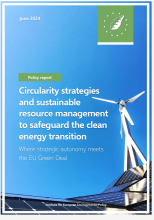
This report discusses the EU’s clean energy transition plans, highlighting how circular economy strategies and sustainable resource management can support strategic autonomy while being Paris-compatible.
It aims to inform stakeholders about the EU’s plans to safeguard its clean energy transition ambitions. Specifically, the report highlights how the uptake of circular economy strategies can contribute to the strategic autonomy agenda (with particular regard to CRMs) while being compatible with the Paris Agreement and the Sustainable Development Goals. It also reflects on the EU’s overall material footprint in the context of global equities as the Union transitions to a climate-neutral and circular economy.
The Dutch company Corbion grows microalgae in closed fermentation tanks where they transform sustainable sugars into algae in a few days. The algae are then used to produce omega-3 DHA (docosahexaenoic acid). These fatty acids provide essential nutrients for humans and many animal diets.
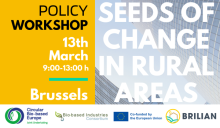
The BRILIAN project workshop "Seeds of Change in Rural Areas" will address several crucial policy-related topics, including developing new materials from agricultural feedstocks.
There will be presentations by representatives of the European Bioeconomy Bureau, the Circular Bio-based Europe Joint Undertaking and the European Commission's Joint Research Centre (EC-JRC), as well as a round table session on unlocking resources from agricultural produce and waste.
Biorefine Cluster Europe (BCE) links up projects and people in the area of bio-based resource recovery, with a view to contributing to more sustainable and circular resource management.
It focuses on the biorefinery sector, i.e. chemicals, materials, energy and products from bio-based waste streams:
Bio-based (waste) streams as an input for the circular economy
Bioprocesses
Sustainable bio-energy production in its various shapes, and
Resource recovery: extracting minerals, chemicals, water and materials from biomass.
Its main objectives:
Strengthening interaction between projects
Fostering dissemination and stakeholder outreach
Enhancing research
Identifying gaps in knowledge.
BCE aims to build its community and promote knowledge exchange.
Municipalities are seeking to reduce waste generation and increase recycling rates in order to cut greenhouse gas emissions. Materials that evade recycling are typically landfilled or incinerated.
This study compares cost effectiveness between sorting of mixed waste leftover after separate collection (leftover mixed waste sorting) and the capture of CO2 from incinerator flue gas for underground storage (carbon capture and storage, CCS).
It has found that the most cost-effective way of delivering system-wide reductions in CO2 emissions is the sorting system. The least cost-effective means to reduce CO2 is CCS. Combining the two would achieve the greatest overall reduction and reduce the average cost of reduction to around half the cost of achieving reduction through CCS alone.
The European Climate, Infrastructure and Environment Executive Agency (CINEA) has commissioned a study on the development of recyclability indexes for photovoltaic products (PV modules and inverters).
The Horizon Europe project InvestCEC aims to develop a replicable model for implementing circular economy projects in cities and regions and so is calling for entrepreneurs to submit their projects.
Selected candidates will have the chance to present their circular economy solutions and receive detailed expert feedback from experienced business consultants, venture capital experts and the public sector at no cost.