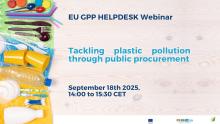
Approximately 400 million tonnes of plastic are produced globally each year.
If tender documents require recycled materials, encourage reuse or repurposing of plastic-containing products, and prevent the use of single-use plastics, then public procurement can play a pivotal role in curbing the plastic crisis.
This webinar will present examples of how contracting authorities can limit plastic waste and pollution through procurement decisions.
A coalition of European cities has published a policy brief calling on EU institutions to strengthen the enabling framework for local circular economy implementation. The Circular Cities Frontrunner Group, consisting of cities such as Amsterdam, Milan, Malmö, Copenhagen, Turku and Porto, has developed the brief as a shared contribution to the EU’s 2024-2029 political cycle.
The policy brief builds on a joint open letter addressed to Members of the European Parliament in late 2024 and outlines how cities can help scale the circular transition - if the right policy conditions are in place.
The brief contributes to ongoing discussions around the Circular Economy Act, the EU’s competitiveness agenda and the future of multilevel governance.
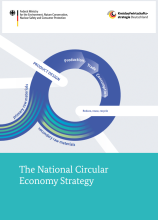
Germany's National Circular Economy Strategy adopts a strategic vision focused on reducing the consumption of primary raw materials. This approach is guided by the proposal from the International Resource Panel, under the United Nations Environment Programme (UNEP), which sets a global target of 6-8 tonnes of raw material consumption per capita per year by 2050.
The strategy considers every stage of the cycle: product design, material selection, production, maximising the use phase and, finally, reuse and recycling. It aims to prevent waste from being created in the first place. This can be achieved through smart product design, efficient manufacturing, extended product lifespans, easier repairability and maximising the recycling of all materials.
CircularPSP (Public Service Platforms for Circular, Innovative and Resilient Municipalities through PCP) brings together eight leading circular economy cities, representing 45 million people. Its focus is pre-commercial procurement.
It is organising a Green Week Partner Event to present its AI tool for public procurement.
Due to rising demand and shrinking supply, the built environment and its raw material suppliers must align with regenerative cycles. This thesis aims to create a circular procurement framework to determine and preserve building asset value at end-of-life, establishing transparent, measurable standards that reduce waste and optimise resources.
It creates a transparent and measurable standard for the circular procurement process, reducing waste and optimising resource use. The thesis focuses on four major deliverables: a database of site and inventory inspections, an exit scenario and resource recovery plan, a partial deconstruction plan, and an online marketplace for resource trading.
The framework uses existing tools and indicators to establish the circular procurement process.
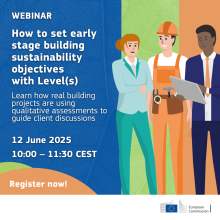
The European Commission is hosting a special webinar to show how the Level(s) common language framework for the sustainability performance of buildings supports early-stage qualitative assessments and reporting.
The session will dive deep into how Level(s) performance indicators help buildings professionals prioritise aspects of sustainability and align client and design team expectations from the concept stage of a building’s lifecycle.
Circular Summit Fryslân 2025 will highlight the power of regions in shaping a circular future.
With keynote speeches, hands-on working sessions and inspiring field trips, this event will bring together circular changemakers with a view to fostering international cooperation.
This online event, organised by the Circular Economy Network (C-PRONE), aims to highlight best practices from different countries in overcoming legal fears surrounding circular procurement.
It will also explore how the interpretation of the EU public procurement directive differs across Member States, leading to varying levels of confidence in applying circular criteria.
The inclusion of green clauses in public procurement contracts is gradually becoming an obligation in certain sectors in the EU.
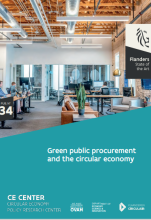
This report highlights the role of green public procurement (GPP) in the transition to a circular economy through an analysis of the European regulatory framework. It looks at both hard (e.g. Batteries Regulation) and soft law (European Commission working documents). Relevant European legislation that is still in the adoption phase (e.g. Construction Products Regulation) is also considered.
An overview of useful model clauses for implementing GPP shows how these clauses can contribute to promoting the circular economy in public procurement. The study lists measures that could make GPP a more effective tool in the circular economy transition.