For New York's design week, NYCxDESIGN in May 2018, the Finnish Cultural Institute in New York invited chefs from the Helsinki-based Restaurant Nolla to bring their zero waste food philosophy to New York. The temporary bistro was built on themes of circular economy, new material innovations and sustainable design.
In the Douro Valley of Portugal, the research and development project Da Vide has created a range of products using grapevine residues – from paper to pens – avoiding the use of plastics and wood and using agricultural waste as a resource.
A team of researchers from the Faculty of Science and Technology of the University of Coimbra (FCTUC) has developed an innovative wastewater treatment technique using natural flocculants extracted from waste eucalyptus wood.
The ReSeaclons project, led by the Marine Institute of the Seaquarium in Grau-du-Roi, France, is committed to bringing together fishermen, seafarers, public authorities, associations, companies, civil society and holiday-makers to help reduce marine pollution.
In Venturis HoReCa a group of professionals has joined forces, knowledge, expertise and ideas to tackle the problem of food waste. They have developed an IT system (KuMin.Gastro) to monitor and reduce food waste in kitchens and canteens. Monitoring of food waste is the first important step in the process of reduction. Venturis HoReCa also advises companies on how to limit food waste.
Re-Match has a recycling process for synthetic turf, recovering up to 95% of the materials, which is accredited with the EU’s Environmental Technology Verification. Their patented technology separates the sand, backing, rubber and plastic fibre from used synthetic turf. These materials can then be sold or used in a wide variety of new products in different industries.
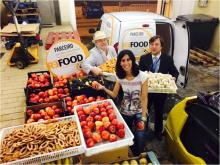
Re-food is an independent, citizen driven, fully volunteer, eco-humanitarian community charity, working to eliminate food waste and hunger on a neighbourhood basis. This Portuguese movement targets at ending food waste and hunger by saving food which was going to waste at local venues.