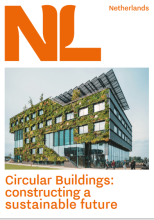
Circular Buildings: constructing a sustainable future: a new brochure which explores how the circular economy can help tackle challenges in the resource-intensive building sector.
Circular Buildings: constructing a sustainable future is the latest addition to a series of publications from Holland Circular Hotspot about circular challenges and opportunities in different sectors including infrastructure, plastics, manufacturing and textiles and apparel industries.
It explores how circular economy concepts can help tackle challenges in the building sector, supporting the transition towards a more sustainable and futureproof industry. It provides 25 good practices from the construction value chain and offers a framework for an international shift towards circular construction comprising policies, measurement standards, collaboration initiatives and knowledge exchange.
The consortium CIRCULAR FoodPack worked on solutions to enable the circular use of plastic packaging, focusing on the most sensitive product category: food. The project aimed to develop recyclable packaging with at least 50% post-consumer recyclates incorporated behind a functional barrier.
In March 2022, the European Commission released its EU strategy for sustainable and circular textiles in the Circular Economy Action Plan framework. The strategy aims at setting a framework to boost the competitiveness, sustainability and resilience of the EU textile sector.
Six months after its release, where do we stand? Join the ECESP leadership group on Textile and all speakers during this #EUCircularTalks event on 26 September, from 14:30 - 16:00 CEST, to discuss the EU textile strategy, its implementation and vision for the current textile industry.
The conference Towards a Circular Economy: Competences for Youth aimed to enable participants from different backgrounds to learn more about the outputs from the Circular Economy - Sustainable Competences for Youth (CESCY) project, to share their views and to hear from experts from different sectors.
The worsening climate crisis and the growing scarcity of natural resources have increasingly demonstrated the limits of our predominantly linear economy. There is no question that our business models and practices must become more sustainable and circular. It is therefore essential that young people be prepared to contribute and lead the way towards a more circular economy in Europe and beyond.
On Thursday 23 June 2022, from 13:30 to 15:30 CEST, the United Nations Environment Program will be hosting a webinar to celebrate the 20th anniversary of the Life Cycle Initiative. The event will take stock of how Life Cycles Approaches have accelerated the transition to sustainable consumption and production.
NP-bioTech uses a biocatalyst, adsorbed onto an inert material (catalytic substrate). This enables the accelerated fermentation of critical biomass (such as citrus pulp or sewage sludge), transforming it into a biostabilised and pasteurised material with excellent agronomic properties.
The Hydro Ben project focuses on resource recovery for reuse in other industrial activities. It consists of recovering fatty substances from wastewater in professional catering facilities, by means of a special device which is placed under the sink.