In 2019 the European Commission set out a policy guideline to address global environmental challenges and circularity. EURATEXand its members welcome the ambition of the EU Institutions to change the old way and commit to engage with all relevant parties to deliver and implement a new Textile Strategy to boost the circular economy and be fit for the present and future generations.
This strategy by EURATEX is a starting point, with insights into solutions based on a 14-month consultation with members, involving over 100 companies and key stakeholders, focused on applied circular practices and future opportunities. It prioritises removing barriers to a large-scale uptake of circular economy in textiles, sets out 12 key points and puts forward 38 proposals.
In line with a circular economy strategy, the company Favini and chocolatiers Domori have developped an industrial symbiosis system to produce the ecological paper Crush Cocoa from cocoa processing waste.
In 2016, the Italian National Agency for New Technologies, Energy and Sustainable Economic Development (ENEA) set up a Symbiosis Users Network (SUN) to boost industrial symbiosis in Italy. The network promotes circular economy models through industrial symbiosis by focusing on operational issues.
SUN's 2019 conference was devoted to Good practices of industrial symbiosis in Italy and the contribution of regional policies as a strategic lever. The event, co-organised by SUN, Ecomondo and ENEA was held in Rimini (IT) on 7 November 2019 at Ecomondo - a leading event in Europe for new circular economy models.
Reports on ENEA-promoted conferences on industrial symbiosis are available here.
Clariter is an international clean-tech company with a revolutionary chemical recycling (upcycling) technology that ends the life of plastic by transforming plastic waste into high-value industrial products: oils, waxes, and solvents.
The Circular Economy Action Group led by Forética and composed of 11 companies, among them the ECESP Coordination Group member Ecoembes, presents an analysis on 'The reality of plastics: myths and truths', focused on promoting the development of circular business models.
The National Institute for Circular Economy (INEC) in France is launching the Circular Schools Programme (PEC), an operational project aimed at making schools a model for the circular economy.
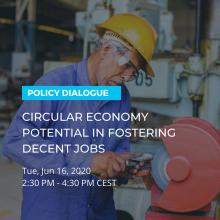
This webinar, organised by Circle Economy, explored the interlinkages between the transition to a more circular economy and quality jobs, drawing on Circle Economy’s recent report on Jobs & Skills in the Circular Economy: State of Play and Future Pathways.
The Ellen MacArthur Foundation invites everyone to discover the circular economy. You are free to explore their learning hub to learn more about the vision for a circular economy.
Research led by Ellen McArthur Foundation in cooperation with Arup highlights the benefits of the circular economy. It outlines five models for real estate business.