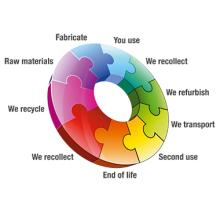
In 2021, the Leadership Group on Retailers, Consumers and Skills considered issues such as how to made the electronics sector more circular, how to boost public awareness of the need to become more circular and how to step up training with a view to reskilling and upskilling.
The European Commission has launched a public consultation on the rules on compensation for damage caused by defective products. A specific focus will be on the use of artificial intelligence in products and services. You can take part in this consultation until 10 January 2022, thus contributing to the process of further developing and fine-tuning this initiative.
The circular economy is a key element of the European Green Deal as a concept that can support the transition towards a more sustainable growth model. In recent years there has been a growth of circular economy industrial applications, but evidence suggests that the uptake of circular approaches in many sectors is still limited.
This report connects the potential for resource efficiency, via circular economy and the value-retention processes (VRPs), with a policy-relevant lens. It is one of the first to quantify the current-state and potential impacts associated with the inclusion of VRPs within industrial economic systems.
In order to do that the assessment applies the different VRPs to a series of products within three industrial sectors and quantifies benefits in relation to the original manufactured product, such as the material requirement, the energy used, the waste as well as the costs and the generation of jobs.
The report also highlights the systemic barriers that may inhibit progressive scale-up including regulatory, market, technology and infrastructure barriers, and how they could be overcome.
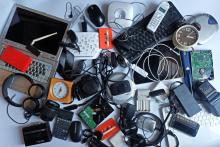
The E-waste Race is an educational competition between ten primary schools to collect old electronic devices. Project participants are given an introductory lecture about recycling and the valuable materials contained in electronic devices. They then start collecting e-waste and the school which collects the most wins an educational - and fun! - school trip.
SNEW has developed a circular system reusing the raw materials in existing equipment. It aims to give business telecoms and IT equipment a second life. Companies which hand over their old ICT equipment get either maintenance for their current equipment or money for the old equipment.