65% of electrical and electronic appliances put on the market must be collected after use when it turns into Waste Electrical and Electronic Equipment (WEEE). One key step in achieving that 65% is to map e-waste streams, reliably and at every stage. The BeWeee tool is designed to help companies in Belgium do so.
The World Circular Economy Forum 2023 will be held in Helsinki from 30 May to 2 June 2023. This global collaboration forum is co-organised by Finnish Innovation Fund Sitra and Nordic Innovation, with international partners. It will attract more than 2 000 leading circular economy players in the world to Finland to find circular solutions that can help our economies fit within the boundaries of nature. Part of the programme will also be accessible online.
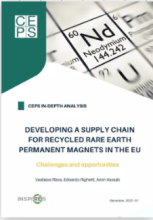
Rare earth elements are strategically important for the EU to sustain and accelerate its green and digital transition, particularly due to their use in permanent magnets. Rare earth permanent magnets are critical components in wind turbines and electric vehicles, as well as home appliances and consumer electronics.
However, faced with an expected surge in demand, limited domestic manufacturing capacity, high import dependency and rising geopolitical tensions, the EU’s ability to meet the future demand for rare earth magnets is at risk.
This report examines the barriers hindering the establishment of a viable magnet recycling chain in the EU, whilst estimating the extent to which recycling could offset the coming increase in demand for rare earth magnets.
The Circular Navarre Catalogue 2022 is an update of the showcasing booklet published in 2020 and in 2021. This new edition includes 50 organisations - based on circular business models - in the Spanish Navarre region, looking for international cooperation.
Article 15 of Directive 2012/19/EU (WEEE Directive) requires producers to provide information free of charge about preparation for re-use and treatment for each type of EEE placed on the market.
To better respond to recyclers’ needs, APPLiA and DIGITALEUROPE created I4R, the Information for Recyclers Platform, where recyclers can access recycling information at product category level.
The WEEE Forum, an international association of producer responsibility organisations and a centre of competence, hosts and maintains the platform. EuRIC is on the advisory board.
Recycling information is linked to the presence and location of materials and components in electronic waste that require separate treatment. There are now 47 product fiches in six product categories.
sets out the background to the Circular Electronics project of the Consumer Insights Action Panel (CIAP),
shares information on the multi-stakeholder circular Electronics Club at the heart of the work, and
provides an overview of the methodology followed in gathering insights, designing and running interventions, and evaluating results and sustainability of the pilots.
It is designed not only to provide an overview of the project’s activities, but also to share learnings, findings and models that could support potential future initiatives in the field of circular electronics and beyond.
While digital networking is of great advantage for everyday life, the incredible amounts of electrical devices bring with it some particularly ecological risks, especially with regard to the use of resources. This is why the European Commission in the New Circular Economy Action Plan announced a Circular Electronics Initiative. There are still many challenges to be discussed during this workshop.
Horizon Europe Framework Programme has published a call on circular economy and bioeconomy sectors. The deadline for submissions is 15 February 2022.
The successful proposal will support the European Green Deal with a topic that will support the transition towards a sustainable, regenerative, inclusive and just circular economy across regions of Europe at local and regional scale.