This research project lists ecodesign criteria for circular fashion and textiles.
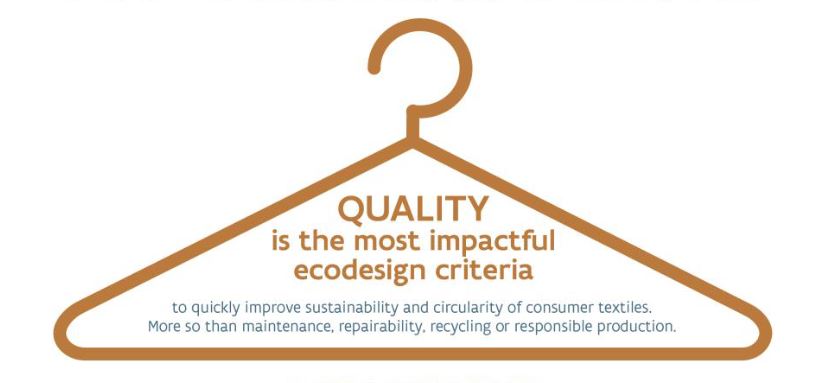
It focused on giving consumer textiles a longer lifespan with optimal reuse potential, making disassembly and recovery possible, and exploring upcycling and high-quality recycling. Extending the life of textile products turned out to have the greatest impact in the short term. Quality seems to be the most impactful ecodesign criterion when it comes to improving the sustainability and circularity of consumer textiles as quickly as possible.
The project defined seven product categories, identifying a set of minimum criteria for each. The report looks at existing labels, standards and regulations and the authors hope it will help expand the Ecodesign Directive by adding a textile category.
Many actors see the EU’s circular economy (CE) as a promising narrative which steps outside dominant end-of-pipe solutions towards an encompassing vision for strategies across the supply chain. However, this study finds that the EU CE Action Plan maintains the status quo narrative instead of suggesting radical changes.
By focusing on stakeholder narratives, this analysis shows that the inertia is primarily due to CE proponents’ self-perception of being in a legitimacy crisis and their strategic arguments that have:
concealed social conflict and potential trade-offs
strengthened the agency of ‘status quo’ agents
excluded alternative voices questioning the proposed CE narrative.
The paper discusses how to develop new environmental narratives outside the status quo.
France's Law Against Food Waste has become an international model for sustainable food policy. The law is often described as combining economic efficiency with environmental protection and social equity. However, stakeholder narratives cast doubt on whether this French CE law really contributes to social justice in the long run. This discourse analysis shows that:
the ban on food waste institutionalised a narrative about food waste that prioritises profit over social equity
the traditionally dominant solidarity narrative about food waste has been pushed back by the emerging CE discourse
As a consequence of this shift, activities enacted in the name of the CE may counteract social equity goals (for instance by establishing competition with charities).
Policies are focusing on halving food waste to help conserve increasingly strained food resources. However, expanding their scope of action to include dietary changes and complement targets with resource footprints has greater potential to save resources while avoiding trade-offs.
This paper shows that in Germany:
Healthy, plant-based diets are more effective at reducing land and biomass use than halving food waste
A combination of more plant-based food consumption and food waste reduction in distribution and consumption is most effective at saving resources
Focusing exclusively on food waste reduction as a policy target can be detrimental to the overarching goal of saving resources because it deflects attention away from more effective alternatives.
Many political, business and civil society stakeholders are disappointed with the German Packaging Act. They feel it makes a comparatively small contribution to the circular economy. This study explains why they are disappointed:
Policy-making became entangled in disputes between proponents of a private and a public system for waste collection. Stakeholder fears of potential radical changes led to a stalemate
Fears allowed only incremental changes in the Packaging Act
The incremental changes could not resolve existing conflicts.
Based on its findings, the paper proposes possible courses of action. To create a shift to a circular economy, dialogue is needed using methods which explicitly address fears and overcome the current stalemate.
Under the framework of the INSIGHT project, a Blueprint has been developed to provide specific recommendations on how to promote the application of Industrial Symbiosis and its facilitation to various stakeholders, as well as a roadmap of how the organisations are expected to apply the IS principles, by making use of educational specific inputs and resources.
This Reflection paper of the ECESP Leadership Group on Network governance and circular economy hubs draws on the lessons learned when a group of ECESP Coordination Group members focused on road-mapping processes in various countries. The key to success is making the networks work, making them actionable, with a focus on network governance and the role of individual circular economy hubs.
The CCRI aims to support Europe’s green transition by boosting circularity at local and regional level. The objective of this call is to select a group of cities, regions or territorial clusters to become the CCRI Pilot Group, which will bring together cities, regions or territorial clusters with a high potential for development in the field of the circular economy.
This book provides answers on how to govern the transition to a circular economy in different socio-cultural and political contexts.
It is intended to help the global changemakers who are building our circular future. Author Jacqueline Cramer spoke with 20 representatives of circular hotspots worldwide, thoroughly analysed their different contexts and extracted 10 key takeaways. Everyone working on circular initiatives can use these and adapt them to their own socio-cultural and political contexts.