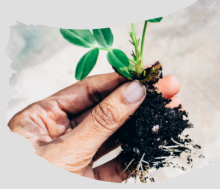
In Italy and France, where the IN.TE.SE project was developed, new decentralised composting services were designed and implemented for domestic and community users, tailored to the local areas.
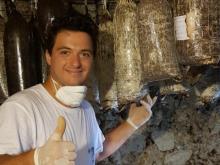
Coffee grounds contain many nutrients which are excellent for growing mushrooms. This secondary raw material is even ready for use, having been sterilised at 80 to 90°C by the coffee machine. What's left once the mushrooms have been collected is a good fertiliser.
Greenful products are the first ones in the market that utilise textile, plastic and rubber waste from the construction industry on a large scale. The panels are made of shredded textile waste that has been pressed and bonded together using a proprietary manufacturing process and are designed to replace various types of wood-based construction panels.
This model reinforces Wallonia's objective of renewing its industry and will ensure that the region is better able to cope with future crises.
The strategy will achieve this by fully integrating the alterations and adaptations required by climate change, and by making Wallonia more independent in terms of resources and global supply chains.
Wallonia’s vision is based on the following guidelines:
Moving towards a carbon-neutral economy;
Moving towards a resilient and inclusive economy;
Stimulating innovation as a catalyst with emphasis on the digital transition and nature-based solutions.
Particular attention is paid to the six value chains: Construction, Plastics, Food, Water, Textiles and Metallurgy.
This report connects the potential for resource efficiency, via circular economy and the value-retention processes (VRPs), with a policy-relevant lens. It is one of the first to quantify the current-state and potential impacts associated with the inclusion of VRPs within industrial economic systems.
In order to do that the assessment applies the different VRPs to a series of products within three industrial sectors and quantifies benefits in relation to the original manufactured product, such as the material requirement, the energy used, the waste as well as the costs and the generation of jobs.
The report also highlights the systemic barriers that may inhibit progressive scale-up including regulatory, market, technology and infrastructure barriers, and how they could be overcome.
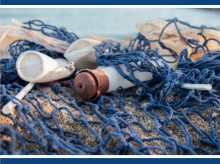
The International Resource Panel think piece provides policy options to reduce marine plastic litter and achieve the Osaka Blue Ocean Vision, which voluntarily commits G20 countries to “reduce additional pollution by marine plastic litter to zero by 2050 through a comprehensive life-cycle approach”.
The report shows the marine plastic litter trends relevant to 2050, summarizes the current plastic policy landscape and explores policy upstream and downstream interventions to reduce marine plastic litter and to transition to a circular plastic economy. They include, among others, actions to design out waste, incentivise reuse, and exploit market-based instruments.
4 Horizon 2020 projects working on biowaste valorisation have teamed up to promote innovative solutions for the circular bioeconomy. This joint initiative is named ROOTS-circulaR pOlicies for changing the biOwasTe System. The projects - HOOP, ValueWaste, Scalibur and WaysTUP - are piloting new solutions to transform urban biowaste and wastewater into valuable products like Feed, Fertilisers, Bioplastics, Biopesticides, Proteins and Bioethanol.
The promoters have discussed their views and shared their concerns on policy barriers hindering innovations that lead to the Circular Economy for urban biowaste. As a result of the discussion, 4 focus topics have been singled out, accompanied by proposed solutions, that will constitute the key messages and be addressed in future initiatives.