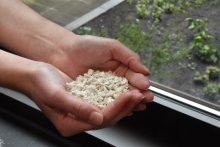
The ECOFAP project aims to make shoe soles and heels from a material manufactured from tanned leather waste using 3D printing. This research project will help solve the problem of how to recycle leather scraps from the footwear manufacturing industry.
How many plastic bottles actually enter the recycling process?
Theory is one thing and reality tends to be another. The Czech Ministry of the Environment wanted to find out what really happens to plastic bottles after they are thrown into sorted bins for plastic waste. It commissioned Adastra to carry out a project using IoT technology to track the movement of sorted bottles.
The Horizon Europe POLYMEER project aims to establish a sustainable bio-based value chain for bioplastic products. By efficiently converting wet brewers’ spent grain into high added value materials, it is endeavouring to diversify the array of innovative material solutions capable of replacing traditional plastics.
The SCALE-UP project helps regional multi-actor partnerships identify and scale-up innovative, sustainable bio-based value chains that build on regional resources.
It aims to adapt, implement and evaluate tools to help regional actors overcome bottlenecks towards fully exploiting circular bioeconomy potential. In this way, it will promote regional, rural, local/urban and consumer-based transitions towards a sustainable, regenerative, inclusive and just circular economy and bioeconomy across all regions of Europe.
The RECERCO project recovered fired sherds, a form of waste generated when manufacturing ceramic tiles. It proved that it is feasible to use this as a secondary raw material for manufacturing new ceramic tiles and as a reinforcement agent for polymeric matrices to obtain composites for the construction industry.
PRIMUS was a research project funded under the Horizon Europe programme, which ran from 2022 to 2025. It researched new polymer recycling technologies, with a view to producing new recycled materials that meet the requirements for manufacturing high value products.
It produced a webinar series on Boosting Plastic Recycling and a number of training courses.
SISTERS is an EU H2020-funded project that aims to design, implement and promote innovations to address bottlenecks at each stage of the food value chain. The end goal is a systemic reduction in food loss & waste.
The GLOPACK project investigated food packaging with no environmental footprint and the ability to extend the shelf life of food products.
It focused on biodegradable and home compostable food packaging made from agro-food residues, bio-packaging and battery-free RIFD bio-sensors to track food freshness.
EIT Climate-KIC is Europe’s leading climate innovation agency and community, supporting cities, regions, countries and industries as they work to meet their climate ambitions through systems innovation and place-based transformations.
Anna Brassa is part of EIT Climate-KIC's leadership team as a Deep Demonstrations Teams Orchestrator. The Deep Demonstrations project, launched in 2019, serves as a testbed for large-scale, place-based demonstrations of sustainable, regenerative living. She also oversees the work performed by Climate-KIC with the Government of Slovenia on the Deep Demonstration of a Circular, Regenerative and Low-Carbon Economy in Slovenia, developing pathways for a more radical transition to climate neutrality through a circular economy, using a systems innovation approach.
TEXroad is a foundation set up to collect and manage data on textiles as efficiently and effectively as possible. The purpose of this collection is to promote and enable circularity in the textiles industry.
They have set up programmes on Paving the way to 2025 and Circular textile data flow, and published reports describing their activities.