The SCALE-UP project helps regional multi-actor partnerships identify and scale-up innovative, sustainable bio-based value chains that build on regional resources.
It aims to adapt, implement and evaluate tools to help regional actors overcome bottlenecks towards fully exploiting circular bioeconomy potential. In this way, it will promote regional, rural, local/urban and consumer-based transitions towards a sustainable, regenerative, inclusive and just circular economy and bioeconomy across all regions of Europe.
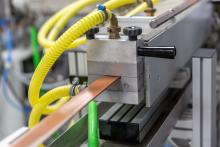
The RECERCO project recovered fired sherds, a form of waste generated when manufacturing ceramic tiles. It proved that it is feasible to use this as a secondary raw material for manufacturing new ceramic tiles and as a reinforcement agent for polymeric matrices to obtain composites for the construction industry.
PRIMUS was a research project funded under the Horizon Europe programme, which ran from 2022 to 2025. It researched new polymer recycling technologies, with a view to producing new recycled materials that meet the requirements for manufacturing high value products.
It produced a webinar series on Boosting Plastic Recycling and a number of training courses.
Resourceful Cities was an URBACT Action Planning Network of nine European cities. The project sought to develop the next generation of urban resource centres. These resource centres see waste as a source of raw materials, thus acting as catalysts for the local circular economy.
The REFLOW project sought to understand and transform urban material flows, and to co-create and test regenerative solutions at business, governance and individual levels to create a resilient circular economy. Projects were carried out in six pilot cities, covering areas such as textiles and energy from waste.
SISTERS is an EU H2020-funded project that aims to design, implement and promote innovations to address bottlenecks at each stage of the food value chain. The end goal is a systemic reduction in food loss & waste.
The GLOPACK project investigated food packaging with no environmental footprint and the ability to extend the shelf life of food products.
It focused on biodegradable and home compostable food packaging made from agro-food residues, bio-packaging and battery-free RIFD bio-sensors to track food freshness.
The Horizon Europe FISSAC project aimed to develop and demonstrate a new paradigm built on an innovative industrial symbiosis model. This model was intended to deliver a zero waste approach in the resource-intensive industries of the construction value chain.
The CircE Project (European regions toward Circular Economy) was an Interreg Europe project implemented during the 2014-2020 financing period. It aimed to reinforce the take-up of the circular economy in Europe.
This platform provides information and updates on two key projects:
CIRCWASTE ran from 2016 to 2023, and aimed to promote the efficient use of material flows, waste prevention and new waste and resource management concepts.
PlastLIFE is an ongoing project (2022 to December 2029), aiming to promote a sustainable circular economy for plastics.