A critical review of the Circular Flanders partnership was conducted in 2023 at the request of its steering group. The report considered what the partnership has set in motion, what significant changes would not have happened without the Circular Flanders partnership, and what would make the partnership even more powerful.
This report takes stock of what Circular Flanders has achieved and what else it can do to promote the circular economy in very practical terms. It lists the projects and initiatives through which the partnership supports the circular transition.
This report summarises the essential results from reports on the biodiversity/circular economy nexus prepared by members of the ECESP's Leadership Group on Biodiversity and Climate.
Its main premise is that biodiversity loss is not only an essential problem for our societies and human well-being but also a key business risk. The report argues that while the circular economy is a key tool for advancing towards our environmental targets, its implementation must be centred around biodiversity and climate considerations.
Reducing the demand for primary resources and preventing waste and pollution at product design stage are crucial, as are policies and measures to promote biodiversity protection and restoration.
During this event in Rotterdam on 10 June, guest speakers Brian Fath, Michael Roos, Katy Gillespie and Şerban Scrieciu will introduce the audience to alternative economic theories, and how these can play a pivotal role in addressing the complex challenges of the Anthropocene era.
This free event is organised by the Erasmus University Rotterdam initiative Dynamics of Inclusive Prosperity, in collaboration with the Interdisciplinary Climate Economics for Nature and Society - ICENS lab.
The circular economy is a powerful tool which cities and towns can use to tackle climate change, reduce CO2 emissions and regenerate nature. Join this online WCEF accelerator session on 17 April to learn how European cities are harnessing circular practices to achieve climate goals and nature restoration in urban settings.
This all-day event in Brussels on 17 April will feature four expert-led sessions, each focusing on different aspects of how circular economy principles can ensure that the built environment remains within planetary boundaries.
The sessions will explore regenerative design, business cases, circular scenarios and blueprints for solutions.
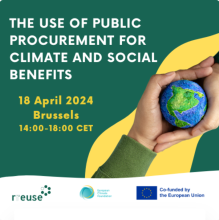
Join RREUSE, Europe’s largest network of social enterprises active in reuse, repair and recycling, for a deep dive into the opportunities and challenges of public procurement as a way to advance climate and social goals.
This half-day conference on 18 April, followed by a chance to network, will bring together EU policy makers, public procurement practitioners and experts, representatives of social enterprises, their networks and Brussels-based NGOs.
The event will also be an opportunity to present RREUSE's report "Advancing climate, environmental and social goals through public procurement".
With the 9 Ilhas Circulares website, the Portuguese public authorities aim to promote a more sustainable lifestyle on the Azores islands.
It is a collaborative online space for exchanging or selling surplus materials, secondhand items and circular services.
This online marketplace has 525 registered users. It fosters a culture of sharing among community members and facilitates donations, with a focus on supporting those in need. In addition to showing products to buy or sell, the platform offers access to a variety of repair, recycling and upcycling services. It has a section on good practices and a space for promoting companies and entities with a sustainable business model.
In December 2021 the Commission adopted a revised Recommendation on the use of Environmental Footprint methods, helping companies calculate their environmental performance based on reliable, verifiable and comparable information. The 2nd public consultation on the Product Environmental Footprint Category Rules for apparel and footwear is now live and will be open until 28 April 2024.