The European Commission is launching an impact assessment for its new initiative: Empowering the consumer for the green transition, and would be keen on some stakeholders' and citizens' feedback until 1 September 2020.
In 2016, the Italian National Agency for New Technologies, Energy and Sustainable Economic Development (ENEA) set up a Symbiosis Users Network (SUN) to boost industrial symbiosis in Italy. The network promotes circular economy models through industrial symbiosis by focusing on operational issues.
SUN's 2019 conference was devoted to Good practices of industrial symbiosis in Italy and the contribution of regional policies as a strategic lever. The event, co-organised by SUN, Ecomondo and ENEA was held in Rimini (IT) on 7 November 2019 at Ecomondo - a leading event in Europe for new circular economy models.
Reports on ENEA-promoted conferences on industrial symbiosis are available here.
The European Commission Joint Research Centre's (JRC) EU Green Public Procurement (GPP) criteria for Road transport is now open for revision. Be part of the process, register as interested stakeholder and comment on the draft Technical report and draft criteria proposal.
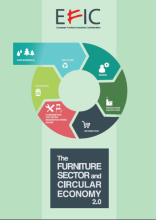
From a “circular” point of view, the wide range of products considered to be "furniture" and the diverse use of materials in production (e.g. wood, plastics, textile, steel, glass, composites, foam) makes it a complex area to address.
The European Furniture Industries Confederation (EFIC) has drawn up a position paper that identifies challenges and opportunities linked to the circular economy transition, covering the different phases of manufacturing from supply of materials to the end-of-life phase, and that provides sector-specific expertise on EU Circular Economy policies.
The European furniture industries are ready to work together with EU institutions to create suitable tools for the sector, enabling it to move in the right direction.
The roadmap is about promoting circular and sharing economy in the city of Helsinki. The main four focuses are construction, procurements, green waste and sharing economy and business opportunities related to circular economy.
Country
Finland
Organisation or body
The Urban Environment Division/Environmental Services
The Ellen MacArthur Foundation invites everyone to discover the circular economy. You are free to explore their learning hub to learn more about the vision for a circular economy.
The report from TCO Development, the organization behind the global sustainability certification for IT products TCO Certified, explains how everyone who buys/uses IT products can implement circular practices. It sets out how circular economy (CE) helps solve many pressing sustainability challenges linked to IT products and contains 33 expert tips on circular IT management.
Key findings:
Use IT products longer.
Circularity helps maximize the value of IT investment.
Market demand is key to accelerating the pace of change.
Circularity includes IT management throughout the life cycle.
Improved supply chain responsibility can speed up transition to CE.
Circularity is a team effort.
Many circular solutions are already in place - just use them.
The European Policy Centre’s (EPC) Task Force called Digital Roadmap to Circular Economy has explored the linkages between digitalisation and circular economy, the opportunities created by data and digitally-enabled solutions, and the challenges associated with harnessing their full potential for the transition to a circular economy.
The project represents a pioneering endeavour in exploring the interconnections between the digital and green transformations and considers the implications for EU policymaking.
The final publication The circular economy: Going digital and its executive summary show that digitalisation can offer enormous possibilities for the transition to a more sustainable, circular economy but it is essential to steer it in the right direction.
The Royal Swedish Academy of Engineering Sciences (IVA) has always been a meeting place for Sweden’s future. It builds bridges between the business community, the public sector, academia and the political sphere.
Its two-year project "Resource Effectiveness and the Circular Economy" was aimed at making Sweden more competitive in a future with finite resources, in line with the UN’s Sustainable Development Goals, by economising on resources and developing new technologies, services and business models in five areas:
premises,
mobility,
textiles,
food and
plastics.
Read the synthesis report, marking the completion of the project, which presents the most important conclusions, recommendations and action plans from the five subprojects.