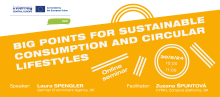
From Niche to Centre (City Centres as Places of Circular Lifestyles) is an Interreg Central Europe project. It aims to revitalise fading city centres by making local trade and consumption more circular and sustainable.
The project is organising a series of webinars: this one will explore Big Points for Sustainable Consumption and Circular Lifestyles. It will identify measures that are particularly important for effective environmental and climate protection.
Tilos is a tiny Greek island, and in 2021 it undertook to become 'zero waste'. And it succeeded: in 2023, it was officially proclaimed a Zero Waste Certified City.
They achieved this by setting up the Just Go Zero Tilos project, in collaboration with Polygreen, a waste management company which provides solutions for industrial waste and marine pollution. The project successfuly minimised waste production and cut out landfilling.
Circe.med is a network of Mediterranean organisations involved in the transition towards ecologically and sustainable ecosystems. Established at the start of 2024, it wants to help deliver a carbon-free, circular economy which will improve people's quality of life.
The initiative aims to deepen, promote and implement a circular economy based on efficient and reduced use of natural resources.
Three main strands:
Sustainable food
Tourism and plastic in coastal areas
The built environment
The network's member organisations strive to deliver an effective circular economy in the Mediterranean which will benefit their individual ecosystems and the region as a whole.
The network is supported by an online platform, Circemed.org, which promotes cooperation and acts as a resource centre.
This is a new and innovative e-learning initiative designed to catalyse the transition towards more sustainable and digitally advanced practices in the manufacturing industry. Freely available to all learners, it provides a comprehensive understanding of the twin digital and green transition in manufacturing companies.
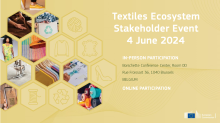
The Textiles ecosystem stakeholder event, organised by the European Commission’s Directorate-General for Internal Market, Industry, Entrepreneurship & SMEs, will take place on 4 June.
There will be updates from the Commission on the EU Strategy for Sustainable and Circular Textiles, the implementation of the Transition Pathway for the Textiles Ecosystem, the EU Pact for Skills and the European Partnership on Textiles under Horizon Europe.
This conference is an opportunity to meet the public authorities and companies involved in the circular economy in the French Drôme Ardèche region.
There will be a main session on a circular and cross-cutting approach for tomorrow's economy, a round table discussion on the regional donut in Valence Romans, five workshops and three site visits.
This workshop, organised by GENIE, will explore a very practical case study of materials reuse. There will be a guided tour of a building where offices are going to be converted into housing as part of a project by the real estate group SPS, the architects' office FdMP and the Matériuum association.
The workshop will see how reuse in the construction sector is coming along in the French-speaking part of Switzerland and explore the impact and technical and economic feasibility.
EU Green Week is an annual opportunity to raise awareness, promote and discuss European environmental policy. This year's focus is Towards a water resilient Europe.
There are two strands: the EU Green Week conference Towards a water resilient Europe, taking place on 29-30 May in Brussels, and the EU Green Week Partner Events, taking place between 29 May and 1 September around Europe. They will focus on water resilience, but there are several on circularity, too - such as Implementing circular economy with EU Ecolabel, taking place on 27 August in Latvia.
Let's Reduce Consumer Food Waste! Solutions from the European Consumer Food Waste Forum will take place on 5 June in Brussels.
This event is organised by the European Commission's Directorate-General for Health and Food Safety and the Joint Research Centre. It is intended for local, regional and national level policy makers, food businesses and other organisations and educational establishments committed to tackling consumer food waste.