To mark its 30th anniversary, the Association of Cities and Regions for sustainable Resource management (ACR+) is delighted to announce that it is launching a photo contest on "Capturing Circularities in Cities and Regions".
The circular economy is a powerful tool which cities and towns can use to tackle climate change, reduce CO2 emissions and regenerate nature. Join this online WCEF accelerator session on 17 April to learn how European cities are harnessing circular practices to achieve climate goals and nature restoration in urban settings.
BIOBUILD, a Horizon Europe-funded innovation project, has been launched with a €4.9 million budget to provide thermal solutions for energy efficient buildings using fully bio-based building materials.
The project incorporates bio-based phase change materials (bioPCMs) into solid wood and fibres bound by plant oil resins, lignin and fungal mycelium. BIOBUILD aims to reduce the energy consumption of buildings by up to 20%.
InvestCEC, working with the DEFINITE-CCRI project as part of the CCRI initiative, is hosting a webinar on "Empowering entrepreneurs for investment success". It will take place on 11 April and aims to enable entrepreneurs to overcome funding challenges and attract investments in the circular economy.
This is an official side event of the World Circular Economy Forum.
This all-day event in Brussels on 17 April will feature four expert-led sessions, each focusing on different aspects of how circular economy principles can ensure that the built environment remains within planetary boundaries.
The sessions will explore regenerative design, business cases, circular scenarios and blueprints for solutions.
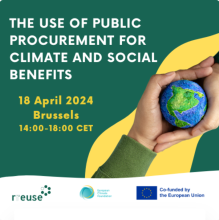
Join RREUSE, Europe’s largest network of social enterprises active in reuse, repair and recycling, for a deep dive into the opportunities and challenges of public procurement as a way to advance climate and social goals.
This half-day conference on 18 April, followed by a chance to network, will bring together EU policy makers, public procurement practitioners and experts, representatives of social enterprises, their networks and Brussels-based NGOs.
The event will also be an opportunity to present RREUSE's report "Advancing climate, environmental and social goals through public procurement".
With the 9 Ilhas Circulares website, the Portuguese public authorities aim to promote a more sustainable lifestyle on the Azores islands.
It is a collaborative online space for exchanging or selling surplus materials, secondhand items and circular services.
This online marketplace has 525 registered users. It fosters a culture of sharing among community members and facilitates donations, with a focus on supporting those in need. In addition to showing products to buy or sell, the platform offers access to a variety of repair, recycling and upcycling services. It has a section on good practices and a space for promoting companies and entities with a sustainable business model.
Circular Computing’s Sustainable IT Summit will take place on 23 April in the United Arab Emirates. It aims to welcome the leaders of some of the largest companies in IT and will combine theory and practice to identify tangible and workable solutions including circular processes such as remanufacturing.