Circular Pointis a service hub providing circular economy solutions for companies and organisations. It was set up by Geonardo, a company which aims to solve complex societal challenges by providing cutting-edge solutions.
Circular Point aims to make its clients more profitable and efficient, while creating a positive environmental, social and consumer impact.
It offers training sessions for companies during which the company's employees are taught how to apply circular principles to its operations, improving both its environmental and financial performance. The hub also works with institutions, local governments and NGOs, showing them how to go circular and convince their target audience of the merits of this shift, and with individuals.
The Collaborating Centre on Sustainable Consumption and Production (CSCP) is an international, non-profit think-and-do tank that works with businesses, policy makers, partner organisations and civil society to deliver a good life for all. They are experts in sustainable solutions and aim to mainstream sustainability.
CSCP is active in fields such as social innovation, sustainable product portfolio and footprint assessments. It provides policy advisory services rooted in scientific research and hands-on experience, and develops focused research and evaluation through real-time prototype testing in a holistic living lab format. It also conducts training and capacity building.
The RECITURF project is developing new methods for recycling artificial turf so that it does not end up in landfills. New artificial turf can be manufactured using the different plastics recovered from waste turf.
There are not many eco-friendly products on the Romanian construction market, so there was definitely a niche in the thermal insulation market. LanaTerm uses sheep's wool to create thermal insulation for buildings.
The Fabric Sales is a designer deadstock fabric store – somewhere individuals and businesses can buy designer fabric which would otherwise be treated as waste.
Together with the students for furniture design of VOMO the CiLAB collective started a journey creating new circular concepts based on textile and furniture waste. The concepts do not only facilitate awareness but also link with the local community and the city of Mechelen.
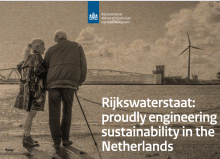
The Netherlands faces major challenges in the domain of sustainability. Its ambition is to create a circular economy and ultimately eliminate CO2 emissions and other greenhouse gases altogether. What does that mean for Rijkswaterstaat?
This report contains a selection of sustainability highlights by Rijkswaterstaat (Dutch Ministry of Infrastructure and Water Management). Inspiring tales of what can be achieved by making full use of everyone’s knowledge and experience, but also a fascinating description of how Rijkswaterstaat has evolved into a sustainable executive organisation for the entire national government.
What steps has the Dutch Ministry of Infrastructure and Water Management Rijkswaterstaat taken in the field of circularity in 2019? You can read everything in this annual report, intended for colleagues, other government agencies, research centres or private parties.
New in this report is the focus on climate neutrality, i.e. the ambition to have zero impact on the climate in all Rijkswaterstaat's work – including that of its contractors. It wants to work in a circular and climate-neutral way by 2030. Both ambitions reinforce each other.
More high-quality recycling of materials, an important principle of the circular economy, means less CO2 emissions and therefore less impact on the climate. On the other hand, working on climate neutrality stimulates the circular transition.
IUCN is a union of government and civil society organisations working to advance sustainable development and create a just world that values and conserves nature.
Created in 1948, it is now the world’s largest and most diverse environmental network, harnessing the knowledge, resources and reach of over 1 400 member organisations and 17000 experts. This makes it the global authority on the status of the natural world and the measures needed to safeguard it.
The European Regional Office represents IUCN at EU level and works with Member States to help deliver EU goals.
IUCN brings expertise and convening power on biodiversity and nature-based solutions to the table, aiming to bridge the environmental priorities of nature conservation and the transition from a linear to a circular model.