Addressing the growing calls for a recovery response that is in alignment with other global challenges, these specifically selected opportunities all optimise the use and circulation of assets, materials and nutrients. As governments take the critical action necessary to safeguard national economies and work towards a transformation that is resilient to future global risks, the circular economy has never been more relevant.
The Circular Plastics Alliance aims to boost the EU market for recycled plastics.
It covers the full plastics value chains and includes over 330 organisations representing industry, academia and public authorities. It is open to all public and private actors from European plastics value chains that are ready to contribute to delivering on the alliance's declaration, specifically that by 2025 at least 10 million tonnes of recycled plastics should find their way into products and packaging in Europe each year.
Companies and business associations are encouraged to submit voluntary pledges on recycled polymer(s) to be produced or used by their organisation by 2025.
The Ministry of Environmental Protection of the Republic of Serbia has developed a Roadmap for the circular economy in Serbia, a document that aims to bring together, connect and promote all those actors whose knowledge, innovativeness and creativity can contribute to a faster transition to the circular economy.
The roadmap seeks to encourage the private sector to use circular business models and to motivate industry to create new jobs, as well as to inspire a shift in business operations through the introduction of innovative and sustainable solutions. The roadmap has been developed by the Circular Economy Platform for Sustainable Development in Serbia project, which was initiated and implemented by the United Nations Development Program (UNDP).
The Circular Cities Week report presents the outcomes of the global event Circular Cities Week including circular challenges and opportunities for cities. It represents a crowdsourced tool for cities worldwide to implement the circular model.
The report explores the association between municipalities pursuing circular economy policy and investments in circular business that create jobs. It also takes a closer look at how businesses perceive this municipal support for circular economy.
The report summarises the findings of a study by the Circular Economy Club (CEC) and the CEC local chapters. The key learnings are as follows:
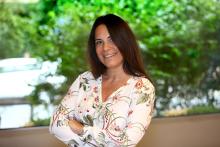
Agnieszka Sznyk is chair of the Board at INNOWO, the Institute of Innovation and Responsible Development in Warsaw, Poland. She holds a PhD in Life Sciences and is an expert in the fields of sustainable production and consumption, circular economy and healthcare economics. Agnieszka has been connected with nongovernmental organisations for many years, notably as founder and manager of the Polish Circular Hotspot and the international educational campaign Circular Week.
Agnieszka serves as an economy expert at the CE Working Group under the National Smart Specializations (NSS) appointed by the Steering Committee, which consists of representatives of the Ministry of Investment and Economic Development, the Ministry of Science and Higher Education and the Ministry of Development Funds and Regional Policy in Poland.
She is author of numerous reports including:
Environmental aspects of eco-design, August 2020
Development of methodology and indicators for various business sectors with regards to circular economy from the regional perspective, December 2019
Methodology for matching circular business models to priority sector implementation, December 2019
Plastics in circular economy, May 2020
INNOWO (the Institute of Innovation and Responsible Development) is a foundation, non-governmental organisation and a THINK-to-DO TANK established to support the development of innovation and implementation of systemic changes for the purpose of sustainable socio-economic progress. The circular economy is the main field of interest and expertise of INNOWO. The organisation supports decision-makers and different stakeholder groups in identifying effective solutions and policy instruments to engage businesses and consumers in achieving a significant and lasting change towards sustainable production and consumption.
Freek van Eijk is CEO of Holland Circular Hotspot (HCH), a private-public platform that facilitates the transition to a circular economy at international level by bringing together government authorities, knowledge institutes and especially businesses. HCH supports knowledge exchange with the aim of stimulating entrepreneurship in the field of the circular economy.
Freek van Eijk is also vice-chair of Circular Biobased Delta, an alliance of Dutch provinces, businesses and knowledge centres pioneering a sustainable circular and biobased economy. He is one of the more senior Dutch experts in the field of waste management and the circular economy. He also serves as Managing Director of Acceleratio.
Previously, Freek van Eijk worked for over a decade as Director of strategy and PA at the multinational SUEZ and as a board member of the Dutch Waste Management Association and the Society and Enterprise Foundation and acted as a Sherpa for the EU Innovation Partnership on Raw Materials.
He has a MSc. Eng. (Delft University of Technology).
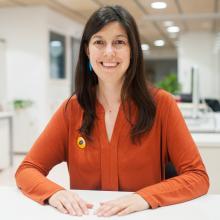
Mercè Boy Roura is a senior researcher and EU project coordinator at the Governance for Sustainability Unit at the BETA Technological Center, based at the University of Vic – Central University of Catalonia (Spain). She is an environmental scientist with a PhD in Experimental Sciences and Sustainability. She has more than 10 years of international experience in research and knowledge transfer projects in the field of sustainability and circular economy, and in particular focusing on the agri-food systems.
She is currently coordinating the Innovative Sustainable Economy (ISE) Mission of the Interreg Euro-MED programme, enhancing the legacy of the previous Interreg MED Green Growth community. The current ISE mission has a broader scope embracing innovation capacities – technological, social, institutional – and practices conducive to more sustainable production and consumption in the region, in line with the European Green Deal and European Cohesion Policy priorities and specific objectives. The ISE Mission is a multi-stakeholder network of projects connecting 155 partners from 18 countries in the Mediterranean region, with a well representation of the 4-ple helix stakeholders. It structures its work around four focus areas: Marine resources, Agri-food systems, Industrial Transition, and Resource Valorisation. Also, it supports projects by increasing their impact at policy level and fostering potential transfer and replication of their results in other regions and by other stakeholders. The ISE Mission is labelled by the Union for the Mediterranean (UfM), acknowledging its potential to advance cooperation in the transition to a green and circular economy in the Mediterranean region.
In 2020, more than ever, we need to work towards building resilient cities which can recover from environmental, social and health crises. CEC believes that the circular economy is a model that will help cities become more resilient. Circular Cities Week will take place on 26 Oct. to 1 Nov. 2020, alongside United Nations World Cities Day.
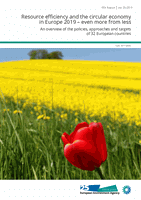
This European Environmental Agency Report presents an analysis of approaches and identifies trends, similarities and new directions taken by countries in resource efficiency and circular economy (CE). It is based exclusively on data provided by 32 Eionet members.
Its main objective is to stimulate exchange of information and good practice between countries and to support capacity building within Eionet.
Another objective is to contribute to various policy processes, including work carried out by European Commission, European Parliament and International Resource Panel.
The report addresses 6 elements:
material resource efficiency and CE in the EU
policy framework
monitoring and targets
examples of innovative approaches and good practice