EU legislation includes recycling targets for municipal, construction and demolition, and electronic waste. This European Environment Agencybriefing shows that there is significant potential to increase recycling from all of these streams.
However, to fully exploit this potential, current barriers need to be overcome. This also requires strong implementation of targeted regulations to increase separate collection.
Implementing new policy measures, some of which are already included in the EU 2020 Circular Economy Action Plan, can both directly and indirectly exploit the potential for increased recycling.
Major Cities in Europe - like Budapest, Copenhagen, Helsinki, Ljubljana, Oslo, Prague and Tirana - have signed the European Circular Cities Declaration inviting peers to join them! The have committed themselves to leading the circular transition and to new models of production and consumption, whilst improving human wellbeing and reducing emissions.
The European Commission has decided to launch a €1 billion call for research and innovation projects that respond to the climate crisis and help protect Europe’s unique ecosystems and biodiversity. The Horizon 2020-funded European Green Deal Call is open for registration. It will spur Europe’s recovery from the coronavirus crisis by turning green challenges into innovation opportunities.
Many European countries still lack a national strategic roadmap for transposing the European directives at national level.
Some outstanding issues include the need to have clearer operational guidelines for the adoption of circular models and metrics for monitoring the transition towards circular models.
This study has been prepared in collaboration with Enel and with the scientific contribution of Enel Foundation. It unfolds in three main parts:
State-of-the-art of Circular Economy in the European Union
An innovative assessment model for socio-economic and environmental benefits of Circular Economy in the EU, with a focus on Italy, Romania, and Spain
Policy proposals for successfully managing the transition from a linear to a circular world.
The Waste Action Plan for a Circular Economy fulfils the commitment in the Programme for Irish Government to publish and start implementing a new National Waste Action Plan. This new national waste policy will inform and give direction to waste planning and management in Ireland over the coming years. It will be followed later this year by an All of Government Circular Economy Strategy. The need to embed climate action in all strands of public policy aligns with the goals of the European Green Deal.
The policy document contains over 200 measures across various waste areas including Circular Economy, Municipal Waste, Consumer Protection and Citizen Engagement, Plastics and Packaging, Construction and Demolition, Textiles, Green Public Procurement and Waste Enforcement.
On 16 September 2020, the President of the European Commission, Ms Ursula von der Leyen, gave her first State of the European Union address. President von der Leyen presented the priorities of the Commission for the coming year where the green transition of the economy and the circular economy hold prominent places.
This research reviews the long history and diversity of circularity thinking to develop a comprehensive timeline, which identifies and conceptually classifies 72 different CE-related concepts from the Global North and South alike (such as industrial ecology, Gandhian and steady-state economics, buen vivir, doughnut economics, degrowth).
In November 2020 the paper was completed with an interactive timeline that helps researchers and practitioners better situate and navigate the concept of circular economy, both in its rich historical origins and in its theoretical diversity. It thus fosters a cross-pollination of concepts and ideas which can help address the complex socio-ecological challenges of the 21st century.
To learn more about this timeline, please click here.
The second of four Thematic Working Groups created by the Interreg MED's Green Growth community was tasked with promoting green public procurement (GPP) by which public authorities seek to procure goods and services with reduced environmental impact throughout their life cycles.
This White Paper provides solutions for GPP and addresses issues linked to the lacking integration of sustainability and circular economy criteria in GPP and the provision of public services. It also highlights the need to develop the capacity of private actors to adopt eco-innovation and green energy in order to participate in green e-tenders.
The main objective is to examine public procurement in the context of long-term impacts, with specific attention paid to the role of public authorities.
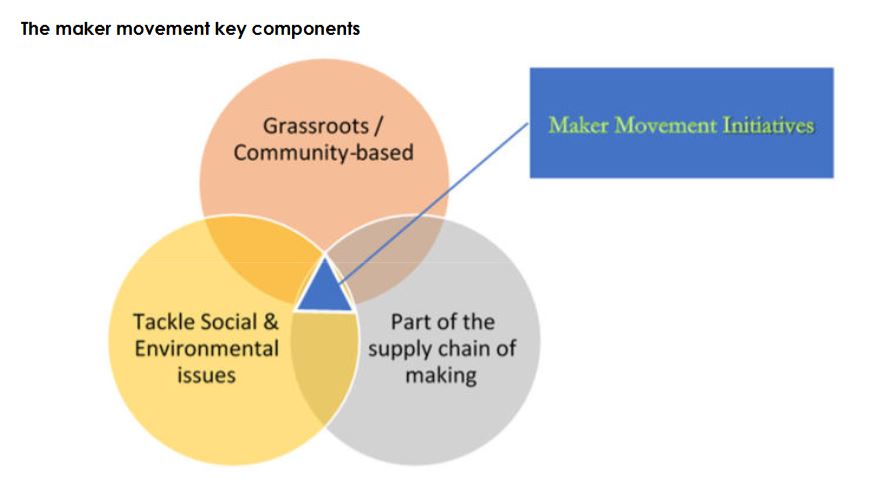
The Pop-Machina project is an EU-funded research project exploring the maker movement contributions to cities’ transition to the circular economy.
This 2nd deliverable 'Mapping the maker community ecosystem and the urban metabolism processes' draws a collection of definitions to characterise the circular maker movement. A set of original tools, including a decision tree, a taxonomy, indicators and maps of the circular maker movement are developed to delineate the circular maker movement, with a focus on the Pop-Machina seven pilot cities.
Eventually, pilot story-boards present the current status of the circular maker movement in the city, with the disclosure of the circular maker passports, characterising the movement in each pilot.
Circular Public Procurement (CircularPP) is a 3-year project (2017–2020) supported by the Interreg Baltic Sea Region programme. CircularPP has published Recommendations to national policy-makers on circular public procurement.