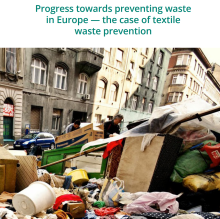
Waste prevention is the best waste management policy option, according to the waste hierarchy - the EU's main rule for the environmental ranking of waste management policies. Its main objective is to reduce waste generation, the environmental impacts of waste management and the hazardousness of the waste generated.
To support this objective, the EU and all its Member States have put in place legislation that promotes activities in products' life cycles aimed at reducing the amount of waste generated.
This report aims to assess progress towards the main objective of waste prevention: decoupling (i. e. breaking the link between waste generation and economic growth).
This briefing provides a snapshot of the status of trading non-hazardous, recyclable waste within the EU. Its aim is to provide knowledge and information to support the review of the EU's Waste Shipment Regulation.
The idea is to improve the functioning of secondary material markets by offering insights and potential solutions to help ensure that waste is treated in the best possible way in line with the principles of the waste hierarchy.
The authors of the study apply ascendency analysis (a systematic method based on information theory for quantifying the efficiency and resilience of natural ecosystems) at EU level and discuss the implications for urban waste management systems, taking the Netherlands as an example.
They argue that ecological principles can be useful for developing human-made systems. The system is made sufficiently robust to be able to cope with shocks by including a diverse set of stakeholders who provide:
resource-use efficiency through specialised know-how in capturing, processing and delivering a range of resources, and
resilience by generating multiple paths that allow these vital resources to circulate throughout the urban network at different levels and rates.
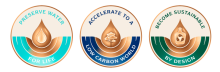
Reduce water use in Diageo's operations with a 40% improvement in water use efficiency in water stressed areas and 30% improvement across the company.
Other (Sustainable management of water)
To be achieved by:
Replenish more water than Diageo uses for their operations for all their sites in water-stressed areas by 2026.
Other (Sustainable management of water)
To be achieved by:
Invest in 150 projects to improve access to clean water, sanitation, and hygiene (WASH) in communities near Diageo sites and local sourcing areas in all of Diageo's water-stressed markets.
Other (Sustainable management of water)
Start Date:
Engage in collective action in all of their Priority Water Basins to improve water accessibility, availability and quality and contribute to a net positive water impact.
Recycling (also including specific waste streams)
To be achieved by:
Achieve zero waste in Diageo's direct operations and zero waste to landfill in Diageo's supply chain.
Recycled materials as part of raw materials demand (recycled content)
To be achieved by:
Ensure 100% of Diageo's packaging is widely recyclable (or reusable/compostable).
Recycled materials as part of raw materials demand (recycled content)
To be achieved by:
Continue to reduce packaging and increase recycled content in Diageo's packaging (delivering a 10% reduction in packaging weight + increasing the % recycled content of the packaging to 60%).
Recycled materials as part of raw materials demand (recycled content)
To be achieved by:
Ensure 100% of Diageo's plastics are designed to be widely recyclable (or reusable/compostable) by 2025 and achieve 40% recycled content in Diageo's plastic bottles by 2025, and 100% by 2030.
Other (Sustainable agriculture management)
To be achieved by:
Provide all of Diageo's local sourcing communities with agricultural skills and resources, building economic and environmental resilience (supporting 150,000 smallholder farmers).
Other (Sustainable agriculture management)
To be achieved by:
Develop regenerative agriculture pilot programmes in 5 key sourcing landscapes.
Other (Accelerate to a low carbon world)
To be achieved by:
Become Net Zero carbon in Diageo's direct operations.
Other (Accelerate to a low carbon world)
To be achieved by:
Reduce Diageo's value chain carbon emissions by 50%.
Other (Accelerate to a low carbon world)
To be achieved by:
Use 100% renewable electricity across all of Diageo's direct operations.
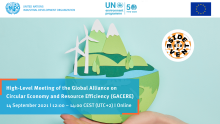
You are invited to follow GACERE's (Global Alliance on Circular Economy and Resource Efficiency) first high-level meeting online on 14 September 2021 in the sidelines of the upcoming World Circular Economy Forum.
Pryme converts plastic waste into valuable products on an industrial scale. It has developed a new approach to an existing and proven chemical recycling technology. Pryme has optimised the pyrolysis process by adding proprietary characteristics.