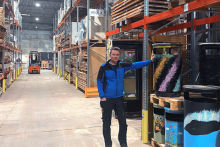
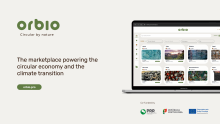
Loopfront is a web-based platform which enables organisations to save costs, reduce CO2 emissions and minimise waste through reuse. It can be used to support operations within a given organisation or between organisations.
TEXTALE is an NGO co-funded by the EU which aims to make Lithuania's textile economy circular.
It promotes the prevention, reuse and innovative recycling of textile waste, helps organisations implement EPR schemes for textiles in the Baltic countries, and brings society and organisations together to create sustainable solutions.
SYNCRETIX assists organisations with designing and implementing ESG transformation, circular economy solutions and resilience strategies.
Their approach integrates circular economy principles across the entire lifecycle of products, buildings and urban systems while strengthening climate resilience, resource efficiency and long-term sustainability.
Berlin's Zero Waste Agency aims to make Berlin a zero-waste capital. As well as providing useful information via its website, it organises Zero Waste Action Weeks each year and brings together stakeholders in working groups and general meetings.
Carbon Expert is a consultancy firm that helps companies prove that their business model is sustainable and meets certification criteria. The companies can then generate funding via Voluntary Carbon Certificates.
CircuLaw is an open-source knowledge platform that helps policymakers, project leaders and purchasers effectively utilise existing laws and regulations to accelerate the transition to a circular economy.
The SCALE-UP project helps regional multi-actor partnerships identify and scale-up innovative, sustainable bio-based value chains that build on regional resources.
It aims to adapt, implement and evaluate tools to help regional actors overcome bottlenecks towards fully exploiting circular bioeconomy potential. In this way, it will promote regional, rural, local/urban and consumer-based transitions towards a sustainable, regenerative, inclusive and just circular economy and bioeconomy across all regions of Europe.
INEC is a French multi-stakeholder association made up of more than 200 public and private organisations: businesses, local authorities, associations, professional federations and universities. Founded in 2013, INEC is now recognised as the leading think tank in France on resource preservation. It aims to promote the circular economy, link up the key issues of the green transition and identify achievable trajectories for making production and consumption models sustainable.
INEC has three main activities :
Produce and publish studies to meet the need for objective data on the circular economy;
Shape proposals and work with public authorities to ensure that the legislative framework is geared to the circular economy;
Support public and private actors as they implement circular strategies.
Marine Courmont Lelieur is in charge of INEC's activities in Europe and around the world. Advocating for resource preservation, she covers topics related to circular economy policies, international partnerships and EU-funded projects. She has a Master's degree in European environmental policies and expertise in the circular economy.
EIT Climate-KIC is Europe’s leading climate innovation agency and community, supporting cities, regions, countries and industries as they work to meet their climate ambitions through systems innovation and place-based transformations.
Anna Brassa is part of EIT Climate-KIC's leadership team as a Deep Demonstrations Teams Orchestrator. The Deep Demonstrations project, launched in 2019, serves as a testbed for large-scale, place-based demonstrations of sustainable, regenerative living. She also oversees the work performed by Climate-KIC with the Government of Slovenia on the Deep Demonstration of a Circular, Regenerative and Low-Carbon Economy in Slovenia, developing pathways for a more radical transition to climate neutrality through a circular economy, using a systems innovation approach.