The new Circular Economy Action Plan identifies textiles as a key product value chain with potential to boost the EU market for sustainable and circular textiles. The European Commission is organising a series of targeted stakeholder workshops to gather input on challenges and gaps as well as opportunities for the sector towards sustainability. Join the second workshop on 2 June 2021!
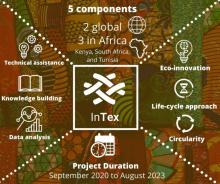
"Innovative Business Practices and Economic Models in the Textile Value Chain" (InTex) is a three-year UNEP project funded by the European Union. The InTex project has five components, two with global reach and three focusing on national implementation in three African countries: Kenya, South Africa and Tunisia.
CIRAA is a company active in promoting circular economy principles and helping businesses ensure that their plans and projects abide by those principles.
A new partnership led by the UNIDO is looking for interested organisations to express their interest in joining ‘SWITCH to Circular Economy Value Chains’ - a five-year European Union-funded project that aims to accelerate the transition to more circular value chains (namely textiles and garments, and plastic packaging) in developing countries.
Commissioned by the Scientific and Technical Advisory Panel (STAP), which advises the Global Environment Facility (GEF), and co-authored by Circle Economy and Shifting Paradigms, this report uncovers the range of socio-economic and environmental co-benefits that circular mitigation interventions can bring to GEF countries of operation.
The report supports strategic advice by the STAP to the GEF and its implementing partners, and helps carve out a role for these bodies in accelerating the transition to a low-carbon circular economy. Its findings will be highly relevant to the development of future GEF projects and programmes across its different focal areas.
The Italian project BIOCOSI (BIOdegradable and COmpostable packaging for sustainable, circular and smart industry) came up with a revolutionary solution to the problem of wastewater in the dairy sector.
Sitra works with partners from different sectors to research, trial and implement bold new ideas that shape the future. It aims to make Finland a pioneer in sustainable well-being.
It is a future-oriented fund which creates preconditions for reform, spurring everyone towards making a change and providing opportunities for co-operation.
Sitra’s work focuses on supporting a fair transition to a circular economy and investigating how business can be based on sharing instead of ownership. Sitra is also working to advance circular trade policies, to increase the understanding of environmental effects of digitisation and to explore the potential of the circular economy to safeguard biodiversity.
The report on Sustainable Plastics Strategy was prepared by the European Technology Platform for Sustainable Chemistry (SusChem) and its partners: Cefic, PlasticsEurope, European Plastics Converters (EuPC) and the European Composites, Plastics and Polymer Processing Platform (ECP4).
One of the keys to tackling plastic waste is the creation of a circular economy. However, the circular economy for plastics is not just about waste. Eliminating leakage and stepping up the use of secondary materials may be part of the picture, but the transition to renewable inputs completes it.
This report outlines the future research needed to fulfil the objectives of the European Strategy for Plastics and the Green Deal priorities.