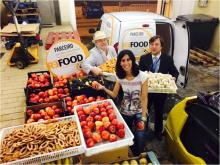
Re-food is an independent, citizen driven, fully volunteer, eco-humanitarian community charity, working to eliminate food waste and hunger on a neighbourhood basis. This Portuguese movement targets at ending food waste and hunger by saving food which was going to waste at local venues.
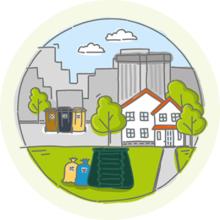
In Slovakia and Czechia, an initiative set by three recent graduates has been positively impacting the sector of waste management in both countries. The Elwis Waste Registration System has the objective to increase efficiency in the cities’ waste management systems by helping reducing the amount of mixed waste.
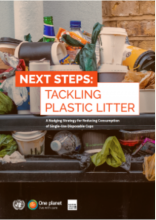
In this report, nudging is explored as a complement to traditional policies (regulation, economic incentives and information campaigns) to reduce the use of single-use plastics. Behavioural insights are used to develop different options to nudge consumer preferences from single-use cups to more sustainable alternatives.
Based on careful reviews and analysis of previous nudging projects, three green nudges are proposed to catalyse this shift.
At 12.00 CET today, watch the launch of the Global Alliance on Circular Economy and Resource Efficiency (GACERE). The alliance brings together governments and relevant networks and organisations to provide a global impetus for initiatives related to the circular economy transition, resource efficiency and sustainable consumption and production, building on efforts being deployed internationally.
The New European Bauhaus is a creative and interdisciplinary initiative, a space of encounter to design future ways of living, at the crossroads between art, culture, social inclusion, science and technology, in the name of simplicity, functionality and circularity. Its team is planning a series of information sessions to present the opportunities to contribute to the initiative.
The Nordic working group on Circular Economy and Nordic Swan Ecolabel have investigated the potential for developing ecolabels for the growing sharing economy. Their findings are set out in a Study into the Potential Framework for Ecolabelling of Sharing Based Services in a Circular Economy Perspective.
The study examines sharing economy sectors and gives some recommendations:
a screening model has been developed which indicates which market/business models ecolabels should focus on in future;
ecolabels should adopt a medium broad definition of the sharing economy, divided into its three main groups: gig, peer-to-peer and access economy;
ecolabels should focus on the transport sector and the entertainment business.
The Collaborating Centre on Sustainable Consumption and Production (CSCP) is an international, non-profit think-and-do tank that works with businesses, policy makers, partner organisations and civil society to deliver a good life for all. They are experts in sustainable solutions and aim to mainstream sustainability.
CSCP is active in fields such as social innovation, sustainable product portfolio and footprint assessments. It provides policy advisory services rooted in scientific research and hands-on experience, and develops focused research and evaluation through real-time prototype testing in a holistic living lab format. It also conducts training and capacity building.
The transition from a linear to a circular economy is one of the most important imperatives of our time: it requires a fundamental change in the way we produce and consume. A circular approach to production and consumption reduces emissions and pollution, increases competitiveness, and boosts innovation.
On 18 January 2021, the co-design phase of the New European Bauhaus is officially starting! The launch was announced by Commissioners Gabriel and Ferreira.