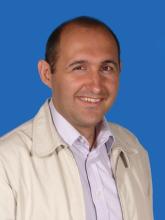
Alberto Arroyo Schnell is responsible for policy and programmes at the European Regional Office of the International Union for Conservation of Nature (IUCN). He has held leading positions on EU environmental policy for the past 15 years. His current focus is working together with the key sectors related to / impacted by / benefiting from biodiversity and nature, aiming to find ways to achieve the environmental targets jointly and to ensure ownership of these targets by all stakeholders. He is Spanish, with a background in Forestry Engineering.
The Regional Association of Solid Waste Management Agencies of Central Macedonia and the Hellenic Ministry of the Environment and Energy present the pilot project "No more Christmas trees in landfills". The project recycles discarded trees, using the wood chips as a secondary raw material to make pellets, biofuels and chipboards, and as organic waste for composting.
ASPAPEL is a Spanish association for pulp and paper manufacturers. They work to promote the sustainable and competitive development of their member companies, focusing on applying circular methods to the recycling of used paper.
Their key areas are:
environment,
energy,
forestry,
recycling,
industrial relations,
occupational risk prevention,
public communications.
The association is governed by a General Assembly and a Management Board with assisting committees and working groups.
The European Commission has decided to launch a €1 billion call for research and innovation projects that respond to the climate crisis and help protect Europe’s unique ecosystems and biodiversity. The Horizon 2020-funded European Green Deal Call is open for registration. It will spur Europe’s recovery from the coronavirus crisis by turning green challenges into innovation opportunities.
Cork-A-Tex is a project that uses recycled cork to create a yarn with high incorporation of cork. Cork is a 100% natural material made from the oak cork trees which can be recycled after its use as cork stopper in wine bottles.
The EU-funded DigiCirc project aimed to digitalise the circular economy by building on the innovation potential of SMEs in three strategic areas: Circular Cities, Blue Economy, Bioeconomy.
Open calls for each domain were launched to select 45 consortia of SMEs. The consortia took part in one of the three acceleration programmes to transform concepts into robust business models, a process which was completed in 2022. DigiCirc Open Courses disseminate the contents developed for the three acceleration programmes.
European project BIOnTop obtains promising results in development of new recyclable and compostable packaging. In its first year, BIOnTop has achieved good results in its experimental work on copolymers and compounds with customized biodegradability and multifunctional coating solutions with customized properties.
The aim of Poland's Roadmap towards the Transition to the Circular Economy (CE), which was adopted in 2019, is twofold: first, to identify cross-cutting measures capable of having the broadest possible impact in Poland, both socially and economically; and second, to prioritise areas that will enable Poland to take advantage of its current opportunities, and to deal with existing or future challenges.
The Roadmap focusses on 5 areas in particular:
Sustainable industrial production
Sustainable consumption
Bioeconomy
New business models
implementation, monitoring and financing of CE.
The Roadmap includes a set of tools, which are not purely legislative, to create the conditions for a new economic model in Poland.