The 4th International Conference on Strategies toward Green Deal Implementation – Water, Raw Materials & Energy (ICGreenDeal2023) will take place on 14-15 December. It will tackle climate change and ways to prevent it, including innovative solutions (technological, environmental, economic and social) that can be implemented under the Green Deal Strategies.
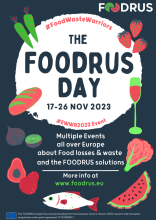
On 29 September - the International Day of Awareness of Food Loss and Waste convened by the Food and Agriculture Organization - the European Food Information Council (EUFIC) launched a one-month food waste campaign, together with a new quiz on Evaluate Your Food Waste Practices!
The quiz provides personalised tips encouraging people to take simple steps at home. It's intended to help identify what kind of information they need to reduce the amount of food they waste. Once people have a better understanding of how to reduce food waste, they'll feel empowered to act.
The FOODRUS first policy roundtable on legal and economic barriers to food waste prevention and reduction will take place online on 11 October at 10:00 – 12:00 CET. During this interactive meeting, barriers identified by FOODRUS partners will be presented and explored with meeting participants.
After Pazardzhik, Barcelona and Naples, the Biocircularcities partners are coming to Brussels on 28 September. Come and be inspired to bring the Biocircularcities approach to your garden by learning more about the project and its results. Discuss the future of a circular bioeconomy in Europe and exchange notes with your peers.
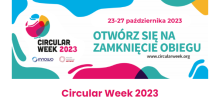
Circular Week, an international series of events dedicated to sustainable development and the circular economy, will take place this year from 23 to 29 October.
Look through the full agenda of events and sign up!
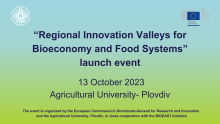
This launch event on Regional Innovation Valleys for Bioeconomy and Food Systems will take place on 13 October 2023. It is organised jointly by the European Commission's Directorate-General for Research and Innovation and the Agricultural University of Plovdiv, in close cooperation with the BIOEAST Initiative. It will be webstreamed and recorded.
Global biodiversity is being lost at an unprecedented rate, giving rise to a sixth mass extinction and constituting one of the core challenges of the triple planetary crisis. Biodiversity forms the foundation of life on Earth and its loss presents a systemic risk to future human survival. To reverse the biodiversity crisis, transformative systems-wide change is required.
This paper addresses an existing research gap by exploring whether the circular economy can play a role not only in halting biodiversity loss but also in regenerating it and thereby contributing to a nature-positive future. To unlock the regenerative potential of the circular economy, a coherent strategy is needed that provides incentives for all actors, notably policymakers and businesses.
This online meeting on 18 September 2023 will discuss which further recycled nutrient products might be appropriate for certified Organic Farming, based on practical examples, and under what conditions they might be considered.
Questions considered: solubility and plant availability of nutrients, origin of raw materials, chemicals used in recovery process and life cycle assessment, contaminants and safety.
Examples will be: calcined phosphates, biochars, phosphate fertilisers from ashes, recovered ammonium sulphate, recovered nutrients from aquaculture and other marine wastes.
"Dialogues on the Circular Economy: Strategies for Transitioning from Food Waste Reduction to Zero Food Waste in the EU" will be held by Greenio on 4 September 2023 in Paris. The event will bring together top minds in sustainability, business and policy to explore and promote effective strategies for eliminating food waste in the European Union.
On 20 September, the Fraunhofer EU Office in Brussels will be holding a workshop to discuss its Roadmap for the Future Development of the Circular Bioeconomy. The workshop will explore the scientific and technological potential and challenges of the bioeconomy, how the bioeconomy can meet ecological and socioeconomic needs, and the policy framework needed to achieve this.
Participants will seek to identify solutions for the four application areas of bioeconomy: nutrition, biomass material utilisation, CO2 value creation and the socio-economic aspects of the bioeconomy.