The 2022 Circular Cities Declaration Report is a very important milestone. Not only is it the first progress report for the European Circular Cities Declaration, it also features statements from 40 signatory cities. This makes it the broadest ever assessment of circular economy practices across European cities.
The report shows that considerable progress is being made: half of the 40 cities involved in the programme already have circular economy strategies in place or in development.
This is just the start. By the end of 2025, the aim is to have 150 cities signed up to this Declaration. Together, the signatories are embedding circularity into European cities!
Cities are hubs of humanity, often fuelling a country’s economic growth and innovation. However, they are also resource and energy hungry. As a result, cities are critical when it comes to helping societies shift to a circular economy.
The 2022 Circular Cities Declaration Report is a very important milestone. Not only is it the first progress report for the Declaration, it also features statements from 40 signatory cities. This makes it the broadest ever assessment of circular economy practices across European cities.
This webinar on Monitoring the Transition to Circular Economy will provide an introduction to the concept of monitoring frameworks within the context of circular economy initiatives. Drawing on experiences from the ground, it will discuss practical examples from cities and regions and related challenges.
A brief presentation of the Self-Assessment Tool, which is being developed by the Circular Cities and Regions Initiative Coordination and Support Office (CCRI-CSO), is also on the agenda.
The World Circular Economy Forum 2023 will be held in Helsinki from 30 May to 2 June 2023. This global collaboration forum is co-organised by Finnish Innovation Fund Sitra and Nordic Innovation, with international partners. It will attract more than 2 000 leading circular economy players in the world to Finland to find circular solutions that can help our economies fit within the boundaries of nature. Part of the programme will also be accessible online.
On 15 December 2022 the H2020 Pop-Machina community will gather once more in a hybrid event to exchange lessons learnt, best practices, and success stories over the Circular Maker Accelerator programme that has been successfully executed in several municipal makerspaces, effectively supporting over 100 makers.
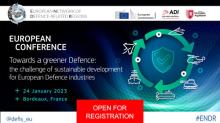
On 24 January 2023, the European Commission is co-organising the Conference “Towards a greener Defence: the challenge of sustainable development for European Defence industries”.
This in-person event will take place in Bordeaux, France, in the framework of the European Network of Defence-related Regions.
The Hydro Ben project focuses on resource recovery for reuse in other industrial activities. It consists of recovering fatty substances from wastewater in professional catering facilities, by means of a special device which is placed under the sink.
This book provides answers on how to govern the transition to a circular economy in different socio-cultural and political contexts.
It is intended to help the global changemakers who are building our circular future. Author Jacqueline Cramer spoke with 20 representatives of circular hotspots worldwide, thoroughly analysed their different contexts and extracted 10 key takeaways. Everyone working on circular initiatives can use these and adapt them to their own socio-cultural and political contexts.
In this book, Jacqueline Cramer shows how network governance can power the circular economy. Network governance is about building a coalition of partners, which all fulfill a specific function in the network and are aligned by so-called transition brokers. By complementing conventional, public governance with this new form of governance, the best of both worlds is created.
Prof. Cramer shares her huge experience of implementing numerous circular initiatives in the Netherlands. As a practitioner and scholar, she has identified ten guiding principles for building circular initiatives, based on network governance. These guidelines can support everyone who wants to start or expedite a circular initiative.