PEACOC was a pre-commercial H2020 pilot project for the efficient recovery of precious metals from European end of life resources with novel low-cost technologies.
Are you involved in a local circular economy activity? Join the Hubs4Circularity Community of Practice launch event on 24 February to learn about our opportunities in advancing circular value chains, and help us shape our new knowledge platform to meet your needs.
The World Circular Economy Forum 2023 will be held in Helsinki from 30 May to 2 June 2023. This global collaboration forum is co-organised by Finnish Innovation Fund Sitra and Nordic Innovation, with international partners. It will attract more than 2 000 leading circular economy players in the world to Finland to find circular solutions that can help our economies fit within the boundaries of nature. Part of the programme will also be accessible online.
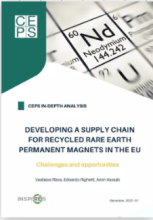
Rare earth elements are strategically important for the EU to sustain and accelerate its green and digital transition, particularly due to their use in permanent magnets. Rare earth permanent magnets are critical components in wind turbines and electric vehicles, as well as home appliances and consumer electronics.
However, faced with an expected surge in demand, limited domestic manufacturing capacity, high import dependency and rising geopolitical tensions, the EU’s ability to meet the future demand for rare earth magnets is at risk.
This report examines the barriers hindering the establishment of a viable magnet recycling chain in the EU, whilst estimating the extent to which recycling could offset the coming increase in demand for rare earth magnets.
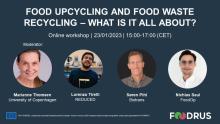
Organised by the University of Copenhagen as part of the FOODRUS project, this online workshop is the second in a series of eight workshops discussing innovative solutions for surplus food loss and waste prevention. Taking place on Monday 23 January 2023 (15:00-17:00 CET), it will focus on food upcycling and food waste recycling.
The roadmap for Ostrobothnia (Finland) provides practical examples on how to get started or develop sustainable thinking, based on the latest research and current trends. The focus is on developing concrete guides, tools and checklists to make the change easier for entrepreneurs.
Get started - Focus on sustainability
Facilities & energy - Less is more?
Raw materials - Everything starts from the choice of materials
Design & product development - Right from the start
Purchases - Have courage to set strict requirements
Production & manufacturing - Produce for the future
Transports & distribution - The closer the better
Communication & marketing - Tell!
Sales - New requirements
Waste & recycling - Go through your waste recycling
During a hybrid seminar organised by Foodvalley NL on 14 February 2023, questions concerning, for example, the consumer's perceptions and expectations on upcycled food will be tackled and the potential impact of circular food concepts by creating an optimal outreach to the market and the consumer will be explored with the help of experts of the Upcycled Food Association (UFA) and Innova Market Insights, and several partners of the Upcycling Community.
Plastic is used in many ways and in large quantities across Europe. Environmental concerns make this a key focus for policy. Currently, most policy actions focus on plastic packaging, even though a large proportion of plastics are used for non-packaging applications, such as construction, furniture and consumer electronics.
Improved reporting on the flows of non-packaging plastics is needed to inform the development of effective policies and measures that target this significant waste stream and increase resource efficiency, in line with the aims of the Circular Economy Action Plan.
Article 15 of Directive 2012/19/EU (WEEE Directive) requires producers to provide information free of charge about preparation for re-use and treatment for each type of EEE placed on the market.
To better respond to recyclers’ needs, APPLiA and DIGITALEUROPE created I4R, the Information for Recyclers Platform, where recyclers can access recycling information at product category level.
The WEEE Forum, an international association of producer responsibility organisations and a centre of competence, hosts and maintains the platform. EuRIC is on the advisory board.
Recycling information is linked to the presence and location of materials and components in electronic waste that require separate treatment. There are now 47 product fiches in six product categories.