The Czech company KOMA Modular s.r.o. is taking a new approach to construction: it manufactures modular buildings made up of individual prefabricated units. It's an effective method which avoids the whole material-intensive issue of construction and demolition.
Wood is becoming increasingly important: it is key to energy, construction and decarbonisation, as well as raw material security. In addition, a raft of legislative and non-legislative measures are being prepared by the Czech Republic and the EU on the issue of wood processing and forestry.
Analysising the sector is therefore paramount. After eight months of work, the research team (Think Tank) of the Institute of Circular Economy has published a study on Closing the Loop on Wood: Circular Bioeconomy Opportunities in the Value Chain for Forest Products and Wood in Czechia. It explores the material flow of wood in the Czech Republic and the challenges, weaknesses and opportunities for cross-sectoral use.
Skanska is a leading construction and development company that has made sustainability a crucial part of its operations. With the assistance of Cyrkl, it has taken on the challenge of deconstructing the Merkuria building, revolutionising the industry, saving materials and helping charities in the process.
The Czech Circular Hotspot is operated by the Institute for Circular Economy (INCIEN), a non-governmental organisation that has been promoting circular economy principles since 2014.
CCH aims to facilitate cross-sectoral and international cooperation in the field of the circular economy. It wants to create a space where the public and private sector can cooperate to accelerate the transition towards a circular economy in Czechia.
The hotspot was set up in 2022, and thanks to strong partners and successful models abroad, it has rapidly grown into an effective network. Members include businesses, SMEs, start-ups, NGOs and academic bodies.
As well as networking opportunities, it provides training sessions and information on overviews and trends.
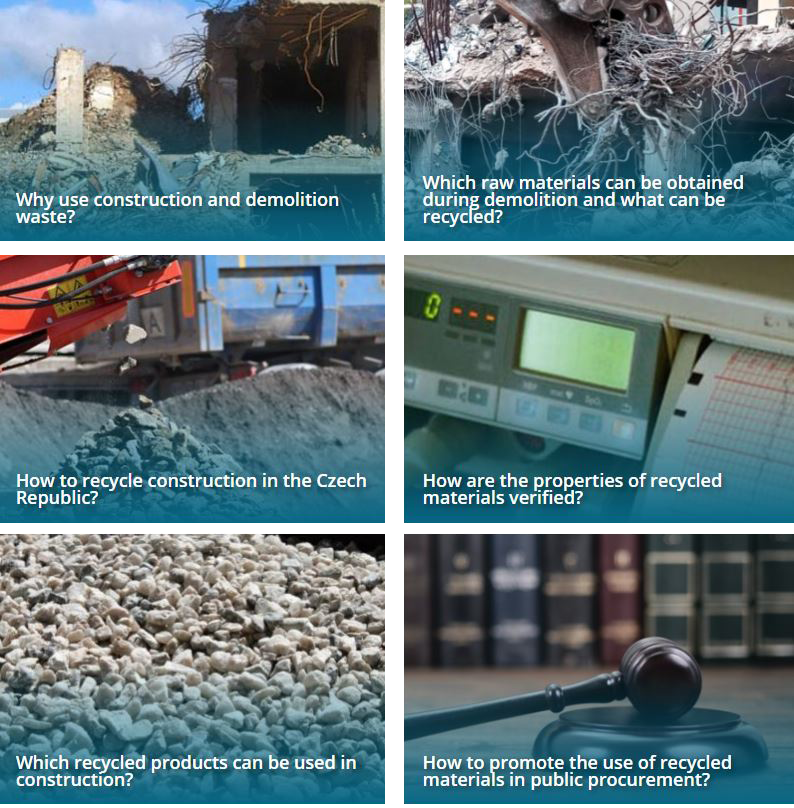
Recyklujme stavby! is a Czech online platform which fosters the standardisation of recycling methods for construction materials.
The platform offers construction professionals a series of services to implement circularity in the sector:
The catalogue of products and materials containing secondary raw materials (an online version of the document for the Czech Standardization Agency) and recycled products
Legislative requirements and related regulations standards
Test procedures for putting recycled products into use.
A glossary of terms to help professionals to get familiar with the issue.
The platform is an initiative of the Ministry of Industry and Trade of the Czech Republic and the Czech Standardization Agency.
MIWA designs and produces genuinely circular packaging for the whole supply chain. It supplies brand owners/producers with smart capsules and retailers with smart dispensers using the service as a product model.
Opravárna operates a web portal putting repair and service businesses in touch with people who need their services. It has also founded the Association Opravme Česko (Let's fix Czechia) in order to to bring together all relevant partners pursuing the same objectives - waste prevention and transition to a circular economy.
In 2017 JRK Waste management introduced an intelligent data system (ECONIT) to reduce the high quantities of mixed municipal waste in Czechia. The programme asks residents to scan their rubbish with QR codes. Information on the quantity and types of waste produced is then used by the local waste management agencies to improve collection and recycling rates.
CIRAA is a company active in promoting circular economy principles and helping businesses ensure that their plans and projects abide by those principles.