The Sustainable products initiative, which will revise the Ecodesign Directive and propose additional legislative measures as appropriate, aims to make products placed on the EU market more sustainable. You are welcome to give your feedback on it until 2 November 2020.
The European Committee of Manufacturers of Electrical Machines and Power Electronics (CEMEP) supports the development towards a circular economy (CE), thus actively contributing to more sustainable manufacturing and responsible consumption. This industrial sector follows a business-to-business market model, delivering products for a wide number of economic sectors and applications.
Its three main product groups – electric motors, variable speed drives and uninterruptable power systems – show differences and similarities when it comes to material efficiency, hence the need for sector- or product-specific approaches when pursuing CE.
This position paper describes the CE status of the CEMEP industries and the way forward towards more circularity.
A new project addressing the systemic complexities of the Circular Economy is being submitted as a Marie Curie (MSCA) post doc proposal. As these aspects build upon multi-stakeholder knowledge and insights, you are kindly invited to join the project community and collaborate.
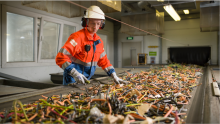
RecyCâbles is a joint venture between Suez and Nexans started in 2008 that collects, recovers and processes used cables. The recycling and re-use of cable materials keeps them in the economic loop.
This case study on the EU's Circular Economy Plan (CEAP) by the Ellen McArthur Foundation reflects back on the steps which the European Commission took to take a lead in circular economy policies globally. From initially aiming at improving resource efficiency, to redefining growth with positive social, environmental, and economic benefits, this case study analyses this policy-making process.
The CEAP was a comprehensive body of legislative and non-legislative actions adopted in 2015, which aimed to transition the European economy from a linear to a circular model. It mapped out 54 actions, as well as four legislative proposals on waste.
By rethinking resource efficiency and material flows, the European Commission has developed a framework to promote systemic change.
PC4Change is a project of the Reware Cooperative - Social Enterprise, specialized since 2013 in the refurbishing of computers dismissed by large companies.
The CirQuality OWL plus project is funded by the EU (ERDF) and the Federal State North-Rhine Westfalia with the aim of fostering the circular economy in the area of Eastern Westfalen-Lippe (OWL).
Several regional partners from different fields (from energy to technologies to food to universities and associations) have teamed up to use the circular economy to get the region off the ground in an innovative, crisis-proof, resilient and sustainable way. Together, they organise events and strive to meet the following goals:
Qualification of future specialists and managers for the circular economy
Circular Supply Chain Management Solutions (SSCM)
Turnaround to circular thinking and economics in the building sector
Waste and circular economy of the future in the OWL region.
AIMPLAS, the Plastics Technology Centre, is coordinating a project called C-SERVEES to develop more circular products like washing machines, laser printers and toner cartridges, TV sets and telecom equipment.
In 2016, the Italian National Agency for New Technologies, Energy and Sustainable Economic Development (ENEA) set up a Symbiosis Users Network (SUN) to boost industrial symbiosis in Italy. The network promotes circular economy models through industrial symbiosis by focusing on operational issues.
SUN's 2019 conference was devoted to Good practices of industrial symbiosis in Italy and the contribution of regional policies as a strategic lever. The event, co-organised by SUN, Ecomondo and ENEA was held in Rimini (IT) on 7 November 2019 at Ecomondo - a leading event in Europe for new circular economy models.
Reports on ENEA-promoted conferences on industrial symbiosis are available here.