The World Circular Economy Forum 2023 will be held in Helsinki from 30 May to 2 June 2023. This global collaboration forum is co-organised by Finnish Innovation Fund Sitra and Nordic Innovation, with international partners. It will attract more than 2 000 leading circular economy players in the world to Finland to find circular solutions that can help our economies fit within the boundaries of nature. Part of the programme will also be accessible online.
The European Cluster Collaboration Platform (ECCP) is an online hub.
It aims to strengthen the competitiveness and sustainability of Europe’s industrial ecosystems, particularly SMEs, improving their performance in terms of productivity, innovation, internationalisation and resource efficiency through a variety of modern tools:
Events to foster capacity building and peer discussions
Matchmaking events
A knowledge database mapping regional, national, international and sectoral cluster networks, toolkits and publications
Partner search and exchange facilities to link up offer and demand
Support for international cooperation
Their Green Transition Support Hub, with a network of institutions offering support for resource and energy efficiency, addresses circularity.
Blue Plastics technology, called CleanBlueTech, is a pioneering, solvent-based, closed-loop washing technology that removes smell, glue, print-ink and organic residues from any plastic flexible film waste.
CleanBlueTech is a game changer as it uses 70% less energy and 100% less water than existing technologies.
The new Horizon Europe project CISUTAC will support the transition to a circular and sustainable textile sector. AIMPLAS will contribute its expertise in the extraction technology for removing inks, dyes and other surface contaminants.
Following the success of Lignofuels 2022 which brought 150+ senior industry professionals to Helsinki in June 2022, we are pleased to announce that the 2023 conference will be taking place in Helsinki again on 8-9 February 2023.
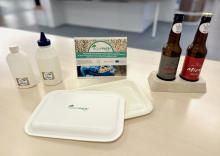
The consortium CIRCULAR FoodPack worked on solutions to enable the circular use of plastic packaging, focusing on the most sensitive product category: food. The project aimed to develop recyclable packaging with at least 50% post-consumer recyclates incorporated behind a functional barrier.
Coffeefrom is an innovative project from Italy. It recovers coffee grounds from the food industry and blends them with biopolymers to form a new bio-based material that is a durable and resistant alternative to single-use plastic.
The BioSupPack project aimed to deliver novel, cost-competitive and versatile bio-based packaging solutions - based on PHA - that demonstrate high-performance for the packaging of food, cosmetics, homecare and beverage products as well as no environmental damage during and after use.
There is an intense debate about how to close the gap between the current climate policy and the aim of the Paris Agreement to achieve close to net-zero emissions by mid-century. The materials and chemicals that heavy industry produces are essential inputs to major value chains: transportation, infrastructure, construction, consumer goods, agriculture.
Material Economics' study starts with a broad mapping of options to eliminate fossil CO2-emissions from production, including many emerging innovations in production processes. It also integrates them with the potential for a more circular economy: making a better use of the materials already produced and so reducing the need for new production.