Recycling Europe (formerly EuRIC) represents the recycling industry at European level and is the leading voice for a competitive European recycling industry, enabling the circular economy and preserving resources for future generations. It:
advocates for conditions that enable recycling and waste management sectors to be competitive, grow and re-invest;
connects the European recycling industries and other circular economy stakeholders;
acts as a trusted partner between the European recycling value chain and policy makers;
Advances the socio-economic, climate and environmental benefits of recycling;
provides specific and cross-sectoral expertise on a broad range of materials, including:
Renewi E-waste collects Waste Electrical and Electronic Equipment (WEEE), recycles it and sells the resulting plastic, ferrous and non-ferrous products as secondary raw materials.
The European Policy Centre’s (EPC) Task Force called Digital Roadmap to Circular Economy has explored the linkages between digitalisation and circular economy, the opportunities created by data and digitally-enabled solutions, and the challenges associated with harnessing their full potential for the transition to a circular economy.
The project represents a pioneering endeavour in exploring the interconnections between the digital and green transformations and considers the implications for EU policymaking.
The final publication The circular economy: Going digital and its executive summary show that digitalisation can offer enormous possibilities for the transition to a more sustainable, circular economy but it is essential to steer it in the right direction.
In April 2020, European Aluminium launched its Circular Aluminium Action Plan, a strategy for achieving aluminium’s full potential for a circular economy by 2030.
The Circular Aluminium Action Plan is the aluminium sector’s strategy for achieving aluminium’s full potential for a circular economy by 2030. The action plan aims to ensure that all end-of-life aluminium products are collected and recycled efficiently in Europe to maximise the aluminium recycling rates and to keep the material in active use. It builds on the aluminium industry’s Vision 2050 and provides policy recommendations for the sector.
The aluminium industry has the potential to be a key driver in achieving Europe’s ambitions for a climate-neutral and circular economy. Aluminium is by nature circular and fit for multiple recycling: it can be recycled over and over again without losing its original properties (lightness, conductivity, formability, durability, impermeability).
The Data Centre Industry (DCI) is one of the most important pillars of current technological and economic developments.
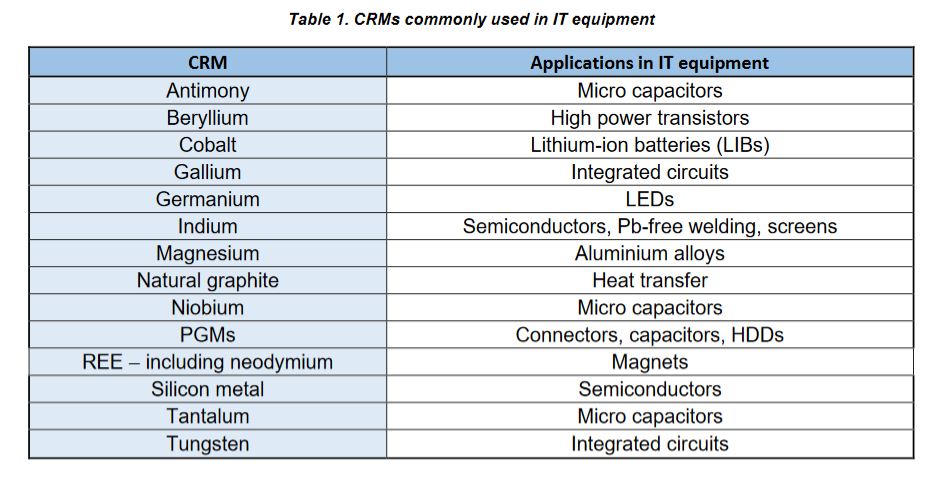
In DCIs, more than fifty different materials can be found per product, including ferrous, non-ferrous metals, precious metals (PM), platinum group metals (PGM), rare earth elements (REE), plastics and/or ceramics, some being considered as Critical Raw Materials (CRMs).
This assessment aims to study DCI design and material composition (specifically servers and switches), as well as to analyse their performance in a circular economy and provide recommendations for ecodesign guidelines.
ekolive provides a new innovative eco-/biological method of zero-waste mining and processing of local primary and secondary raw materials, aimed at creating local resources of metals and minerals.