Research on Remelting and Purification of Si-kerf for PV wafers is part of CABRISS, a European collaboration aimed to develop a circular economy mainly for the photovoltaic but also other industries such as electronics or metallurgy.
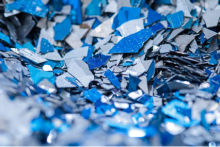
During production of silicon wafers out of silicon (Si) ingots and wafers, about 40–50% of the material is lost due to the cutting technique. The research had kerf from slurry based wafer cuttings undergoing several refining steps and being remelted into ingots for PV-application.
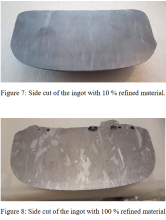
Conclusion: With 10% refined material, ingots were still directionally solidified, whereas with 100% refined material, they were not. The presented refining method does not allow for ingots with 100% refined material to be used as PV-material.
The project Recycling of broken Si based structures and solar cells is part of CABRISS, a European collaboration aimed to develop a circular economy mainly for the photovoltaic (PV), but also for other industries such as electronics or metallurgy.
The paper presents some tests in which broken solar cell structures coming from an early stage in the PV production process chain as well as broken finished solar cells have been recycled into new silicon (Si) feedstock through demetallisation, purification and directional solidification.
The paper explores two different routes to remove diffusion layers and anti-reflection coating (ARC) on broken cells. It also presents the characteristics of ingots produced with the Si-feedstock from the two routes by directional solidification.
The overall objective of BIORECOVER is the research and development of a new sustainable and safe process, essentially based on biotechnology, for selective extraction of a wide range of critical raw materials (CRMs) such as Rare Earths, Magnesium or Platinum Group Metals.
Expertise in technology, medicine and the social sciences
Rare Earth Elements (REEs) are considered as "key enablers" of green technologies. However, they are also the elements with the highest supply risk.
The EU funded project REE4EU has developed processes that may help to regain REEs from RE-containing waste streams.
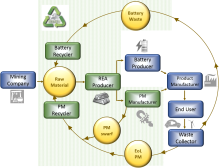
The EU-funded CABRISS project aims at pioneering a circular economy dedicated to handling the critical situation of recycling the considerable amount of photovoltaic waste for the photovoltaic, but also for the electronic and glass industry.
For our future electricity system, a significant amount of wind and solar energy is required. In turn, these energy technologies require some specific critical metals. The current global supply of several critical metals is insufficient to guarantee a transition to a renewable energy system.
Calculations for The Netherlands show that additional wind turbines and photovoltaic panels already require a significant share of the annual global production of some critical metals.
This report outlines the magnitude of the issue and the complexity of the supply chain. It also identifies various paths towards solutions.
This factsheet on Metal Recycling developed by EuRIC highlights the importance of both ferrous and non-ferrous metal recycling and their substantial benefits for the environment and the economy in Europe. The Brochure outlines the environmental benefits, the economic and international trade aspects of steel, aluminium and copper recycling.
ENEA, the Italian National Agency for New Technologies, Energy and Sustainable Economic Development, is carrying out research into lithium-sulphur batteries to make them more competitive.
For four days in 2019, more than 750 company leaders, scientists and policy makers from all over the world came to Antwerp for the World Resources Forum organised by OVAM - the Public Waste Agency of Flanders featuring sessions on the power of the circular economy and the link with climate change, and an introduction to numerous pioneering projects and initiatives that are driving the transition.