Italian fashion retailer OVS has adopted a Circularity Index, which allows to measure the water usage and recyclability potential of its clothes collections.
All products (detergents and cosmetics) at Officina naturae are conceived to be safe and effective for humans and the environment in the name of sustainability, eco-design and circularity.
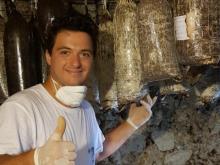
Coffee grounds contain many nutrients which are excellent for growing mushrooms. This secondary raw material is even ready for use, having been sterilised at 80 to 90°C by the coffee machine. What's left once the mushrooms have been collected is a good fertiliser.
This report is published by the Cyprus Federation of Employers & Industrialists (OEB), the Institute of Greek Tourism Confederation (INSETE) and the public policy consultancy adelphi (Germany) as part of the European project Hotels4Climate financed by EUKI.
The report aims to assess the current state of circularity in the hotel industry in Cyprus and Greece by conducting national surveys in both countries targeting hotels in order to:
identify the priority sectors within the main services offered by hotels, the business challenges and opportunities to move to circular economy,
create successful, flexible and resilient circular business models, and
identify a number of internal and external barriers that raise obstacles to the transition to circular economy.
This model reinforces Wallonia's objective of renewing its industry and will ensure that the region is better able to cope with future crises.
The strategy will achieve this by fully integrating the alterations and adaptations required by climate change, and by making Wallonia more independent in terms of resources and global supply chains.
Wallonia’s vision is based on the following guidelines:
Moving towards a carbon-neutral economy;
Moving towards a resilient and inclusive economy;
Stimulating innovation as a catalyst with emphasis on the digital transition and nature-based solutions.
Particular attention is paid to the six value chains: Construction, Plastics, Food, Water, Textiles and Metallurgy.
The circular economy is an alternative to the dominant economic model, which causes considerable damage to the environment as it is based on the linear use of resources.
The development of the circular economy has been hindered by a number of economic, technological and regulatory constraints.
EpE's natural resources commission has spent three years identifying what makes circular economy initiatives successful. An analysis of 27 circular economy initiatives carried out by companies shows that partnerships are one key to overcoming these constraints. A closer examination of these partnerships sheds light on various forms of governance.
18 Italian Consumer Associations sponsored by Eni have identified the challenges to be tackled and the actions to be implemented in order to empower consumers for the circular economy transition in a document titled Circular Consumption Charter.
According to the Charter, circular consumption should be: