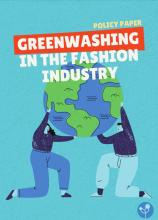
This policy paper sheds light on the false claims and misleading communication campaigns advertised by the fashion industry. It discusses the environmental impacts associated with these greenwashing claims in relation to three issues: materials, circularity and climate.
The paper further presents the most common statements and strategies used by fashion companies to convey their alleged engagement in environmentally sustainable practices.
Finally, recommendations are given on the policies needed on the EU-level to ensure that fashion brands are providing accurate and verifiable information to consumers, for them to make informed choices.
With this policy paper, Generation Climate Europecalls on the EU to address the growing issue of greenwashing in the fashion industry.
Join this year's Nordic Circular Summit exploring the circular economy in the Nordic region on 23–26 November, and learn about the region’s tremendous circular opportunities.
The Circular Economy Hotspot Catalonia 2021 will take place in Barcelona. The 5th edition of the event aims to share circular economy strategies and experiences.
The celebration of this event strengthens the Circular Catalonia hub, a meeting point for companies, institutions, and people ready to put into practice solutions and strategies to consolidate the circular economy in Catalonia.
The Environmental change project promoted proactive reskilling and upskilling to reap the benefits of the ecological transition. The project was in line with the European Green Deal and focused on the circular economy and sustainable solutions.
Active and intelligent packaging is a new and exciting area of technology, the potential of which has received much attention from the food business operators, retailers and consumers alike.
This position paper aims to oversee the barriers identified for the rapid market introduction of active and intelligent packaging and offer recommendations on lifting these barriers. The examples brought forward in this paper are based on the results and experiences from the GLOPACK project and relevant publications, guides and knowledge collected from industry practice.
The French National Institute for Circular Economy (INEC) has published this paper which aims to use schools - a place familiar to all - as showcases for the circular economy. It contains a series of good practices (for public and private actors, youth) comprising over 40 territorial initiatives and 50 operational solutions, on the following themes:
school buildings (construction, renovation)
energy supply
inner/outer spatial planning
stationery-equipment-furniture
school cleaning (products and apparel, staff training)
food loop (local and sustainable food, waste, water fountains)