ACR+ is an international network of cities and regions keen to promote sustainable resource management and accelerate the transition to a circular economy in their area and beyond.
They are working for a future with vibrant cities and regions where economic and ecological systems go hand in hand. This should be achieved by policies geared to fair distribution of wealth and resources and fair access to public services, guaranteeing positive effects on the environment and public health.
They welcome a wide range of stakeholders from Europe and beyond: from local authorities and city networks to NGOs, academics, private partners and consultancies.
The academic paper "Analysing European Union circular economy policies: words versus actions" comprehensively reviews and analyses the EU’s circular economy (CE) policies. Results show a dichotomy between words and actions, with a discourse that is rather holistic, while policies focus on “end of pipe solutions”.
To address these limitations, the paper proposes a set of 32 science-based policy recommendations which can help strengthen circular economy policies both within and outside the EU. This research thus brings key insights for practitioners and academics seeking to better understand the EU’s CE policies and how to improve circular economy implementation at both national and international level.
See here for more results, insights and recommendations.
Concular disrupts the construction industry by developing a circular process for material flow. The system is based on an AI-driven platform that matches buyers’ demand for construction material with suppliers’ circular materials.
In 2020, more than ever, we need to work towards building resilient cities which can recover from environmental, social and health crises. CEC believes that the circular economy is a model that will help cities become more resilient. Circular Cities Week will take place on 26 Oct. to 1 Nov. 2020, alongside United Nations World Cities Day.
The Waste Action Plan for a Circular Economy fulfils the commitment in the Programme for Irish Government to publish and start implementing a new National Waste Action Plan. This new national waste policy will inform and give direction to waste planning and management in Ireland over the coming years. It will be followed later this year by an All of Government Circular Economy Strategy. The need to embed climate action in all strands of public policy aligns with the goals of the European Green Deal.
The policy document contains over 200 measures across various waste areas including Circular Economy, Municipal Waste, Consumer Protection and Citizen Engagement, Plastics and Packaging, Construction and Demolition, Textiles, Green Public Procurement and Waste Enforcement.
The second of four Thematic Working Groups created by the Interreg MED's Green Growth community was tasked with promoting green public procurement (GPP) by which public authorities seek to procure goods and services with reduced environmental impact throughout their life cycles.
This White Paper provides solutions for GPP and addresses issues linked to the lacking integration of sustainability and circular economy criteria in GPP and the provision of public services. It also highlights the need to develop the capacity of private actors to adopt eco-innovation and green energy in order to participate in green e-tenders.
The main objective is to examine public procurement in the context of long-term impacts, with specific attention paid to the role of public authorities.
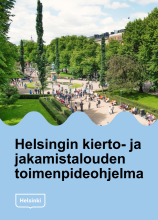
The City of Helsinki’s Action Plan for the Circular and Sharing Economy is the updated version of the original roadmap of May 2020.
The Action Plan now extends to 2035. The focus areas are:
construction
procurement
environmental awareness and sustainable consumption.
Circular economy goals and measures are assembled under each focus area. The intention is to achieve the goals gradually.
Progress will be monitored using the Kiertotalousvahti service (Circular Economy Watch), and reported annually in the city’s environmental report and in the annual report of the European Circular Cities Declaration.
The post-COVID-19 recovery plan should be extensive, as the effects of the pandemic on people and economy have, in many cases, been devastating. The recovery plan must also fully support the green transition to guarantee resilience over the long term.
The circular economy has the potential to raise EU GDP by billions of euros, and create around 700,000 extra jobs by 2030. With this in mind, the economic approach should be an integral part of that recovery. It is one of the messages of a new EUROCITIES policy statement on the EU Circular Economy Action Plan that sets out how cities, as significant engines for economic growth, can drive the circular economy to unlock economic, environmental and social benefits.
However, on behalf of the European chemical distribution sector, particularly the numerous SMEs it represents, Fecc would like to raise the following points:
increasing recycled content in products while ensuring their performance and safety is paramount
stakeholders from across the board – private companies, academia, and public bodies – can all benefit from circularity in the distribution sector
promoting circular public procurement to empower consumers and public buyers is necessary and must be supported post-COVID-19.